
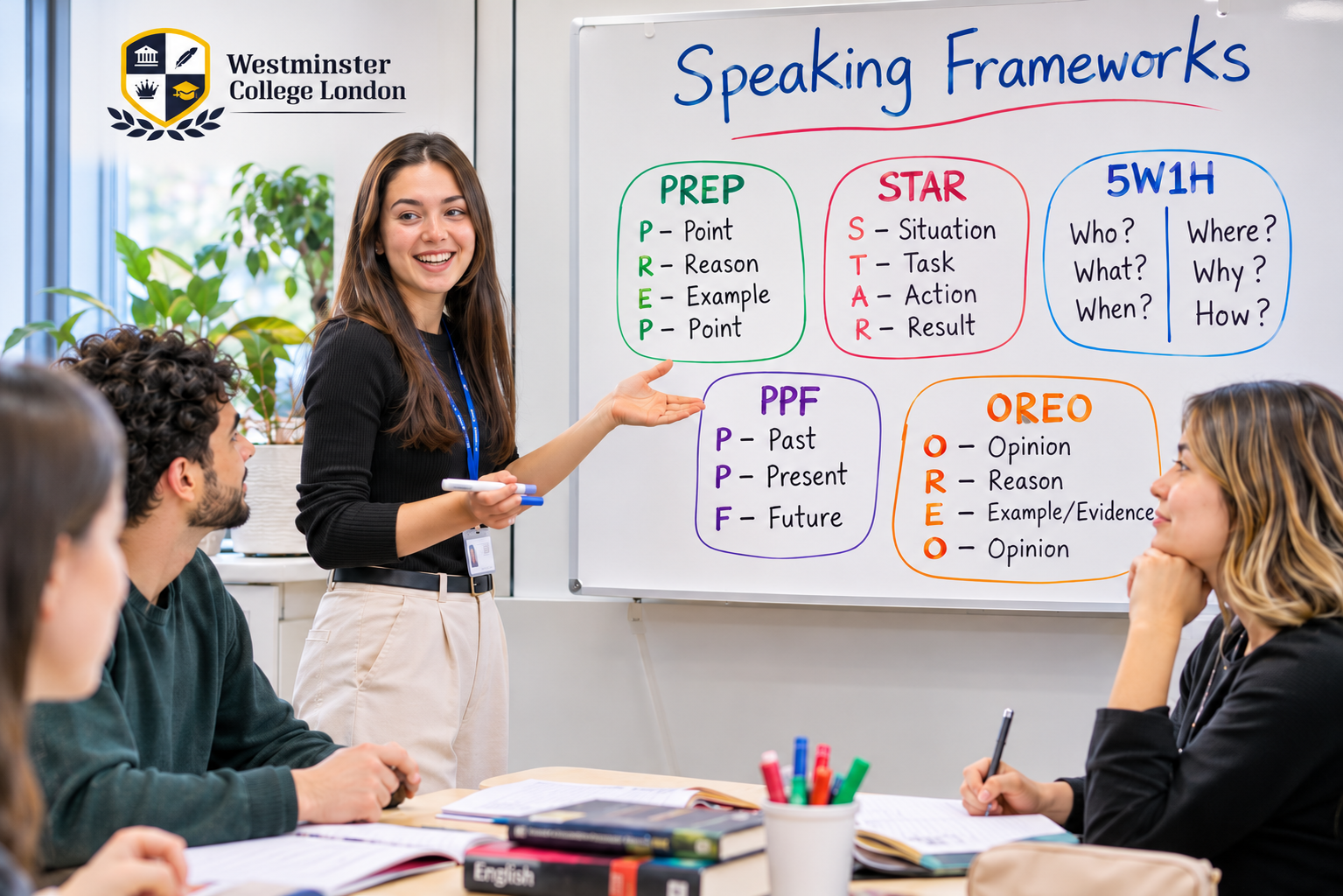
12 Powerful Speaking Frameworks for English Learners: PPF, PREP, STAR, OREO, 5W1H and More
Practical Strategies for Teaching Speaking in the English Language Classroom
By Westminster College London | TEFL & TESOL Teacher Development
Introduction
One of the most common challenges English teachers face is helping students speak confidently and develop their answers beyond a few words.
Imagine asking your students:
"What do you think about learning English online?"
One student answers:
"It's good."
Another says:
"I like it because it's easy."
Although these answers are understandable, they provide limited opportunities for learners to demonstrate their vocabulary, grammatical range, reasoning, and ability to communicate extended ideas.
Now imagine a student responding:
"I think online learning is a useful option because it allows students to study from almost anywhere. For example, people who work full-time can attend evening classes without travelling to a language school. That's why I believe online learning can be particularly beneficial for busy adults."
The second response is longer, more organised, and easier to follow.
But how can teachers help learners produce answers like this?
One practical solution is to introduce structured speaking frameworks, such as PPF, PREP, STAR, 5W1H, and OREO.
These frameworks provide learners with a simple structure for organising their thoughts, developing ideas, giving examples, and communicating more effectively.
In this article, Westminster College London explores 12 useful speaking frameworks, explains when to use each one, and provides practical examples, classroom activities, and a complete lesson plan for English language teachers.
1. What Are Speaking Frameworks?
Speaking frameworks are organisational structures that guide learners through the process of developing spoken responses.
They help students decide:
-
What to say first
-
How to develop their ideas
-
When to provide explanations or examples
-
How to connect different points
-
How to finish their response
For example, a learner using the PREP framework follows four stages:
Point → Reason → Example → Point
Instead of answering a question with one short sentence, students learn how to support their opinions.
Speaking Frameworks vs Teaching Methods
It is important to distinguish between a speaking framework and a teaching method.
Approaches such as Communicative Language Teaching (CLT) and Task-Based Language Teaching (TBLT) guide broader decisions about how language is taught and practised.
Speaking frameworks operate at a different level. They are tools that help learners organise individual responses, presentations, stories, or arguments.
A teacher can therefore use PREP within a communicative lesson, STAR during an interview role-play, or 5W1H during a task-based speaking activity.
These frameworks are not replacements for teaching grammar, vocabulary, pronunciation, fluency, or interaction skills. They are practical forms of support that can be gradually reduced as learners become more independent.
2. PPF: Past, Present, Future
Best for: Personal experiences, describing changes, extended speaking, and IELTS Speaking Part 2.
Suggested levels: A2–C1
PPF is a particularly useful structure for helping students extend their responses by discussing a topic across three time periods.
How PPF Works
Past: What was the situation before?
Present: What is the situation now?
Future: What do you expect or hope will happen?
Classroom Example
Question: How has your English learning experience changed?
Past:
"When I started learning English, I found speaking very difficult. I knew some vocabulary, but I couldn't communicate confidently."
Present:
"Nowadays, I can have conversations with people from different countries. I also watch English films and listen to podcasts regularly."
Future:
"In the future, I hope to improve my academic English and study at an international university."
Why Use PPF?
The framework encourages students to develop a topic from different perspectives rather than stopping after one or two sentences.
It also creates opportunities to use different time references and grammatical structures.
For example:
-
Past simple and used to
-
Present simple and present perfect
-
Future forms and expressions of possibility
Classroom Activity: My English Journey
Ask students to prepare three short notes:
-
When I started learning English ...
-
At the moment ...
-
In the future ...
Students then deliver a one-minute presentation to a partner.
Afterwards, partners ask follow-up questions.
Teaching tip: PPF should be used flexibly. Not every topic naturally requires past, present, and future, and students should not force all three stages into every answer.
The British Council includes PPF among its IELTS Speaking Part 2 teaching strategies.
3. PREP: Point, Reason, Example, Point
Best for: Expressing opinions, supporting arguments, discussions, interviews, and impromptu speaking.
Suggested levels: A2–C1
PREP is one of the most practical frameworks for helping learners develop short opinion-based responses.
How PREP Works
P – Point: State your opinion or main idea.
R – Reason: Explain why you think so.
E – Example: Support your answer with an example.
P – Point: Restate or summarise your opinion.
Classroom Example
Question: Should students have homework every day?
Point:
"I don't think students should have homework every day."
Reason:
"Students need enough free time to relax, exercise, and spend time with their families."
Example:
"For example, students who attend school for several hours may become exhausted if they have too much additional work at home."
Point:
"Therefore, I believe homework should be useful and manageable rather than assigned every day automatically."
Useful Language
StageUseful expressionsPointI think ... / In my opinion ...ReasonBecause ... / The main reason is ...ExampleFor example ... / For instance ...PointThat's why ... / Therefore ...
Classroom Activity: One-Minute Opinions
Prepare several discussion questions:
-
Should schools allow mobile phones?
-
Is online learning better than face-to-face learning?
-
Should children learn a foreign language early?
-
Is travelling the best way to learn about other cultures?
Give students one minute to prepare their ideas.
They then speak for approximately 45–60 seconds using PREP.
Partners listen and identify whether all four stages were included.
Teaching tip: Encourage students to restate the final point naturally rather than simply repeating their opening sentence word for word.
4. STAR: Situation, Task, Action, Result
Best for: Job interviews, personal experiences, problem-solving stories, and professional communication.
Suggested levels: B1–C1
STAR is widely used to organise answers to competency-based interview questions.
It is especially useful when students are asked to describe something they have experienced or accomplished.
How STAR Works
S – Situation: Describe the background or context.
T – Task: Explain what needed to be achieved.
A – Action: Describe what you did.
R – Result: Explain what happened and what you learned.
Classroom Example
Question: Tell me about a time you worked successfully in a team.
Situation:
"Last year, I worked with three classmates on a presentation about environmental problems."
Task:
"We had to prepare a 15-minute presentation and present practical solutions."
Action:
"I organised our meetings, divided the research tasks, and helped my classmates practise their presentations."
Result:
"We completed the project on time and received positive feedback from our teacher. I also learned how important communication is when working in a team."
Why Use STAR?
STAR helps students provide complete examples rather than vague statements.
For instance, instead of saying:
"I'm good at teamwork."
Students can demonstrate their skills through a specific experience.
Classroom Activity: Interview Challenge
Students work in pairs.
Student A acts as an interviewer.
Student B answers questions such as:
-
Tell me about a time you solved a problem.
-
Describe a situation when you helped someone.
-
Tell me about a challenge you overcame.
-
Describe an achievement you are proud of.
Students switch roles after each interview.
Teaching tip: Encourage authentic examples. Students should not invent achievements and present them as real when practising for genuine employment interviews.
The UK National Careers Service recommends STAR for structuring interview answers.
5. 5W1H: Who, What, When, Where, Why, How
Best for: Storytelling, describing experiences, reporting events, information gathering, and classroom interviews.
Suggested levels: A1–C1
5W1H is a question-based structure that helps learners collect and organise relevant information.
How 5W1H Works
-
Who? Who was involved?
-
What? What happened?
-
When? When did it happen?
-
Where? Where did it happen?
-
Why? Why did it happen?
-
How? How did it happen?
Classroom Example
Topic: Describe a memorable holiday.
Who: I travelled with my family.
What: We visited several famous attractions.
When: We went last summer.
Where: We travelled to Istanbul.
Why: We wanted to explore the city's history and culture.
How: We travelled by plane and used public transport during our visit.
Extended Speaking Response
"Last summer, I travelled to Istanbul with my family because we wanted to explore the city's history and culture. We visited several famous attractions, including historical buildings and museums. We travelled there by plane and used public transport to explore different areas. It was a memorable experience because we learned a lot and spent time together."
Classroom Activity: News Reporter
Divide students into pairs.
One student reports an imaginary event, and the other acts as a journalist.
The journalist asks six questions based on 5W1H.
Afterwards, the journalist presents a short report to the class.
Teaching tip: Students do not need to answer the six questions in a fixed order. The questions are prompts for collecting information, not a compulsory speaking script.
6. OREO: Opinion, Reason, Example/Evidence, Opinion
Best for: Young learners, simple debates, expressing preferences, and beginner opinion writing or speaking.
Suggested levels: A1–B1
OREO is a memorable structure for helping students organise and support their opinions.
Different versions use Example or Evidence for the letter E.
How OREO Works
O – Opinion: Say what you think.
R – Reason: Explain why.
E – Example/Evidence: Provide supporting information.
O – Opinion: Repeat or summarise your view.
Classroom Example
Question: Should children play outside every day?
Opinion:
"I think children should play outside every day."
Reason:
"Outdoor activities help children stay active and enjoy fresh air."
Example:
"For example, children can ride bicycles, play football, or spend time in a park."
Opinion:
"That's why I think playing outside regularly is important."
Classroom Activity: The OREO Speaking Challenge
Prepare picture cards showing familiar topics:
-
Pets
-
School uniforms
-
Homework
-
Sports
-
Healthy food
Give each student a picture and a simple question.
Students use an OREO organiser with four sections to prepare their responses.
For younger learners, teachers can provide sentence starters and allow students to use pictures rather than full written notes.
Teaching tip: OREO and PREP are very similar. There is little value in presenting both as completely different strategies in the same beginner lesson. Choose the version that is easiest for your learners to remember.
Additional Speaking Frameworks for English Teachers
The following structures extend the original five and provide teachers with more options for different communication tasks.
7. ARE: Answer, Reason, Example
Best for: Short questions, everyday conversations, and expanding simple answers.
Suggested levels: A2–B2
ARE is a simplified structure that helps learners move beyond one-word responses.
How ARE Works
A – Answer: Give a direct answer.
R – Reason: Explain your answer.
E – Example: Provide an example.
Classroom Example
Question: Do you enjoy reading books?
Answer: "Yes, I really enjoy reading."
Reason: "Reading helps me relax and learn new things."
Example: "For example, I usually read a novel before going to bed."
Classroom Application
Ask students familiar questions about hobbies, daily routines, food, travel, and education.
Begin with ARE before introducing the more extended PREP structure.
This makes ARE particularly useful as a bridge between basic conversations and longer discussions.
8. PEEL: Point, Evidence, Explanation, Link
Best for: Academic speaking, persuasive presentations, debates, and developing arguments.
Suggested levels: B2–C1
PEEL is commonly associated with organising written paragraphs, but teachers can also adapt it to structured speaking.
How PEEL Works
P – Point: Introduce the main argument.
E – Evidence: Support the point with relevant information.
E – Explanation: Explain how the evidence supports the argument.
L – Link: Connect the explanation to the main issue or next point.
Classroom Example
Question: Why should schools encourage group work?
Point:
"Group work can help students develop communication and cooperation skills."
Evidence:
"For example, during a group project, students must exchange information, divide responsibilities, and negotiate decisions."
Explanation:
"These activities require learners to explain their ideas, listen to other perspectives, and work towards a shared goal."
Link:
"For this reason, well-organised group work can be an important part of classroom learning."
Classroom Activity: Mini Debate
Choose a topic:
"Should schools replace printed textbooks with tablets?"
Students prepare one argument using PEEL.
They present their arguments in small groups and respond to questions.
Teaching tip: Evidence should be appropriate to the claim. Encourage students to distinguish personal examples from verified research findings.
9. CAR: Context, Action, Result
Best for: Short interview answers, achievements, problem-solving, and professional experiences.
Suggested levels: B1–C1
CAR is a shorter alternative to STAR.
How CAR Works
C – Context: Explain the situation or challenge.
A – Action: Describe what you did.
R – Result: Explain the outcome.
Classroom Example
Question: Describe a problem you solved.
Context:
"During a group presentation, one of our team members became ill the day before the presentation."
Action:
"I reorganised the speaking sections and helped another teammate prepare the missing material."
Result:
"We delivered the presentation successfully and learned how to adapt when unexpected problems occur."
Classroom Application
Ask students to think of a challenge they have faced at school, work, or home.
Give them three minutes to prepare notes.
They then describe the experience using CAR.
Teaching tip: CAR is useful for shorter responses, while STAR provides a more detailed distinction between the situation and the task.
10. SCQA: Situation, Complication, Question, Answer
Best for: Problem-solving discussions, business presentations, academic presentations, and proposing solutions.
Suggested levels: B2–C1
SCQA helps speakers introduce a problem logically before presenting a response.
How SCQA Works
S – Situation: Explain the current circumstances.
C – Complication: Identify the problem or difficulty.
Q – Question: Introduce the question that needs answering.
A – Answer: Present the proposed solution.
Classroom Example
Topic: Improving the School Library
Situation:
"Our school has a library that students can use during breaks."
Complication:
"However, many books are outdated, and students often struggle to find materials suitable for their English levels."
Question:
"How can we make the library more useful for language learners?"
Answer:
"I suggest adding graded readers, creating a student recommendation system, and organising weekly reading clubs."
Classroom Activity: School Improvement Committee
Divide learners into small groups.
Each group identifies a problem in a school, workplace, or local community.
They prepare a two-minute proposal using SCQA.
Other groups ask questions and evaluate the practicality of the proposed solution.
11. What? So What? Now What?
Best for: Reflection, storytelling, professional development, and discussing lessons learned.
Suggested levels: B1–C1
This reflective structure guides speakers from describing an experience to interpreting its significance and identifying future action.
How It Works
What? Describe what happened.
So What? Explain why the experience mattered or what you learned.
Now What? Describe what you will do differently in the future.
Classroom Example
Question: What did you learn from your first public presentation?
What?
"Last month, I gave my first presentation in English. I was nervous and sometimes forgot what I wanted to say."
So What?
"I realised that I had spent too much time memorising sentences instead of practising how to explain my ideas."
Now What?
"Next time, I will prepare keywords, practise with a partner, and focus on communicating naturally."
Classroom Application
Use this structure after:
-
Group projects
-
Presentations
-
Classroom debates
-
Teaching practice
-
Educational visits
It is particularly valuable in teacher-training courses because it encourages reflection on professional experiences.
12. Problem – Solution – Benefit
Best for: Persuasive speaking, practical recommendations, projects, and presentations.
Suggested levels: B1–C1
This straightforward structure helps students identify a problem and suggest a meaningful solution.
How It Works
Problem: Explain what needs improvement.
Solution: Suggest an action.
Benefit: Describe the expected positive result.
Classroom Example
Question: How can we encourage students to read more?
Problem:
"Many students spend very little time reading outside the classroom."
Solution:
"Schools could introduce a weekly reading club where students choose books based on their interests."
Benefit:
"This could encourage regular reading, provide opportunities for discussion, and help students expand their vocabulary."
Classroom Activity: Solve the Problem
Give groups different classroom or community problems.
For example:
-
Students are often late.
-
The school library is rarely used.
-
Learners avoid speaking English.
-
The classroom produces too much waste.
Each group presents one solution and explains its benefits.
Two More Useful Speaking Structures
Not every effective speaking structure needs an acronym.
The Rule of Three
The Rule of Three organises a response around three main ideas.
Question: What makes a good English teacher?
"A good English teacher needs three important qualities: strong subject knowledge, effective classroom management, and the ability to motivate learners."
The speaker can then explain each quality.
This approach is useful for presentations, discussions, and short speeches.
Compare and Contrast
This structure helps students organise similarities and differences.
Question: What are the differences between online and face-to-face learning?
"Both online and face-to-face learning can provide opportunities to practise English. However, online classes offer greater flexibility, while face-to-face lessons may make spontaneous interaction easier for some learners. The most suitable option depends on the learner's needs and circumstances."
Useful expressions include:
-
Both ... and ...
-
Similarly ...
-
However ...
-
In contrast ...
-
Whereas ...
-
On the other hand ...
This structure is especially relevant to discussion tasks requiring comparison and evaluation.
13. Comparing the Speaking Frameworks
Teachers should choose frameworks according to the communicative purpose rather than teaching every acronym indiscriminately.
FrameworkMain purposeSuggested levelPPFDiscussing change across timeA2–C1PREPExpressing supported opinionsA2–C1STARDescribing experiences and achievementsB1–C15W1HReporting events and developing storiesA1–C1OREOExpressing simple opinionsA1–B1AREExtending short answersA2–B2PEELDeveloping detailed argumentsB2–C1CARReporting problems and achievementsB1–C1SCQAExplaining problems and solutionsB2–C1What? So What? Now What?Reflecting on experiencesB1–C1Problem–Solution–BenefitMaking practical recommendationsB1–C1Rule of ThreeOrganising three key ideasA2–C1Compare and ContrastExplaining similarities and differencesA2–C1
These proficiency ranges are suggested teaching applications, not official CEFR classifications of the frameworks.
14. How to Teach Speaking Frameworks Effectively
Introducing an acronym is not enough to develop students' speaking abilities.
Teachers need to demonstrate the structure, prepare the necessary language, and create opportunities for meaningful practice.
A useful teaching sequence consists of six stages.
Stage 1: Introduce a Communicative Situation
Begin with a meaningful question or task.
For example:
"Should university education be free?"
Ask students to discuss the question briefly.
Observe whether they can support their opinions.
Stage 2: Introduce the Framework
Explain a suitable structure, such as PREP.
Write the four stages on the board.
Use a short model answer to demonstrate how the structure works.
Stage 3: Analyse the Model
Ask students to identify:
-
The main point
-
The supporting reason
-
The example
-
The final conclusion
Use simple questions to check that students understand the purpose of each stage.
Stage 4: Provide Guided Practice
Give students another question.
Provide prompts and sentence starters.
Allow time to prepare keywords.
Avoid requiring students to write and memorise a complete speech.
Stage 5: Organise Communicative Practice
Students discuss the question in pairs or small groups.
Partners ask follow-up questions and respond to each other's ideas.
The teacher monitors language use, organisation, pronunciation, and interaction.
Stage 6: Provide Feedback and Repeat
Give focused feedback on what students communicated successfully and what they can improve.
Then ask them to repeat the task with a new partner.
This provides an opportunity to apply feedback and develop greater independence.
The ultimate objective is not for students to memorise acronyms. It is for them to organise their thoughts and communicate more effectively without depending on a rigid template.
15. Sample 60-Minute Speaking Lesson Plan Using PREP
Topic: Should Students Use Smartphones in the Classroom?
Level: B1–B2
Duration: 60 minutes
Main skill: Speaking
Supporting skills: Listening and note-taking
Learning Objectives
By the end of the lesson, students should be able to:
-
Express an opinion clearly.
-
Support an opinion with a relevant reason and example.
-
Organise an extended response using PREP.
-
Ask and answer follow-up questions.
-
Reflect on and improve their speaking performance.
TimeStageActivities0–5 minLead-inStudents discuss their experiences of using smartphones for learning5–12 minLanguage preparationTeacher introduces opinion, reason, and example expressions12–20 minFramework introductionTeacher presents PREP and analyses a model answer20–30 minGuided practiceStudents prepare individual answers using keywords30–43 minSpeaking taskStudents give responses in pairs and ask follow-up questions43–53 minFeedback and repetitionTeacher provides feedback; students repeat with different partners53–60 minReflection and assessmentStudents assess their speaking and identify improvement goals
Example Model Answer
Point:
"I believe students should be allowed to use smartphones in the classroom for educational purposes."
Reason:
"Smartphones can provide quick access to useful learning resources."
Example:
"For example, students can use online dictionaries, complete interactive quizzes, or record their pronunciation."
Point:
"Therefore, I think smartphones can be useful classroom tools when teachers establish clear rules for their use."
Speaking Assessment Checklist
CriterionNot yet demonstratedWith supportIndependentlyStates a clear opinion☐☐☐Provides a relevant reason☐☐☐Gives a suitable example☐☐☐Organises ideas logically☐☐☐Uses appropriate linking expressions☐☐☐Responds to follow-up questions☐☐☐Speaks intelligibly☐☐☐
This checklist is intended for formative classroom assessment rather than as a standardised speaking examination scale.
16. How to Use These Frameworks at Different English Levels
A1–A2: Beginner and Elementary Learners
Prioritise simple structures such as 5W1H, ARE, and simplified OREO.
For example:
Question: What's your favourite food?
Answer: "My favourite food is pizza."
Reason: "Because it tastes delicious."
Example: "I usually eat it with my family on Fridays."
At these levels, teachers should provide sentence starters, familiar topics, visual prompts, and opportunities to rehearse language.
The emphasis should be on achievable communication rather than lengthy presentations.
B1–B2: Intermediate and Upper-Intermediate Learners
Introduce PREP, PPF, STAR, CAR, and Problem–Solution–Benefit.
Learners can practise:
-
Explaining preferences
-
Describing experiences
-
Justifying opinions
-
Making suggestions
-
Discussing advantages and disadvantages
-
Participating in interviews
Encourage students to use linking expressions and provide more detailed examples.
C1–C2: Advanced Learners
Introduce SCQA, PEEL, reflective structures, and more complex argumentation.
At these levels, students should develop the ability to:
-
Evaluate different perspectives
-
Support claims with appropriate evidence
-
Respond spontaneously to challenging questions
-
Acknowledge limitations and counterarguments
-
Adapt their speaking to different audiences
-
Use appropriate formal and informal registers
Advanced learners should not be restricted to rigid formulas.
They need flexibility to combine, modify, or abandon a framework according to the communicative situation.
17. Using Speaking Frameworks in IELTS Preparation
Speaking frameworks can be particularly helpful for students preparing for the IELTS Speaking test.
However, it is essential to understand their role.
IELTS Speaking is assessed through four criteria:
-
Fluency and Coherence
-
Lexical Resource
-
Grammatical Range and Accuracy
-
Pronunciation
Frameworks such as PREP and PPF can support idea development and coherence, but following a particular acronym does not automatically lead to a higher band score.
IELTS Speaking Part 1
Students usually answer familiar questions about their lives and experiences.
ARE can be useful for extending short answers.
Question: Do you enjoy cooking?
"Yes, I really enjoy cooking because it helps me relax. For example, I often prepare dinner for my family at weekends."
Responses should remain natural and appropriate to the question.
IELTS Speaking Part 2
PPF can help some learners develop an extended response.
For example, when describing an important skill, students could discuss:
-
How they learned it in the past
-
How they use it now
-
How they might develop it further
Students should also address the prompts on the task card rather than forcing every answer into a chronological structure.
IELTS Speaking Part 3
PREP, Compare and Contrast, and Problem–Solution–Benefit can support more analytical answers.
For example:
Question: How has technology changed education?
A student could identify a change, explain its causes, provide an example, and evaluate its consequences.
Important Advice
Avoid teaching students to memorise entire answers or repeat the same expressions mechanically.
Good IELTS speaking requires relevant, flexible, and spontaneous communication.
Frameworks should help students generate ideas, not replace genuine language ability.
18. Five Classroom Activities for Practising Speaking Frameworks
Activity 1: The Framework Challenge
Prepare discussion cards with questions suitable for different frameworks.
For example:
PPF: How has your hometown changed?
PREP: Should children learn English at an early age?
STAR: Describe a time you solved a difficult problem.
5W1H: Tell us about an interesting event you attended.
Problem–Solution–Benefit: How can we make our school more environmentally friendly?
Students select a card and prepare a response.
Activity 2: Improve the Answer
Write a short answer on the board:
"I like travelling. It's interesting."
Ask students to improve it using PREP.
Students work in pairs and compare their revised responses.
Activity 3: Speaking Framework Interviews
Students interview each other using STAR or CAR.
Possible questions include:
-
Tell me about an achievement.
-
Describe a challenge you faced.
-
Tell me about a time you helped someone.
The interviewer asks at least one follow-up question.
Activity 4: Framework Switching
Give students one topic and ask them to organise their answers using two different frameworks.
Topic: Learning English
With PPF, students describe their language learning journey.
With PREP, they explain why learning English is important.
Discuss how the different structures change the purpose of the response.
Activity 5: Record, Reflect, Repeat
Students record a short response using a selected framework.
They listen to the recording and check:
-
Did I answer the question?
-
Were my ideas clear?
-
Did I give enough explanation?
-
Did I provide relevant examples?
-
Was my pronunciation understandable?
-
Did I speak naturally?
Students then record an improved version.
This activity encourages reflection and makes progress easier to observe.
19. Common Mistakes When Teaching Speaking Frameworks
Mistake 1: Teaching Too Many Frameworks at Once
Students may become confused when introduced to several acronyms in one lesson.
Better approach: Begin with one framework that directly supports the lesson objective.
Mistake 2: Turning Speaking into Memorisation
Learners may memorise complete answers rather than develop genuine speaking skills.
Better approach: Encourage keyword notes, flexible language use, and spontaneous follow-up questions.
Mistake 3: Ignoring Pronunciation and Fluency
A well-organised answer is not necessarily easy to understand.
Better approach: Continue teaching pronunciation, sentence stress, intonation, pausing, and fluency.
Mistake 4: Using the Same Framework for Every Question
PREP is suitable for opinions, but it may not be the best choice for telling a detailed story.
Better approach: Match the structure to the communicative purpose.
Mistake 5: Forgetting Interaction
Students might deliver well-organised monologues but struggle to participate in conversations.
Better approach: Include questions, clarification requests, turn-taking, polite disagreement, and responses to unexpected comments.
Mistake 6: Focusing More on Structure Than Meaning
Students may complete all the stages of a framework without providing a convincing or relevant answer.
Better approach: Assess the quality of ideas, examples, and explanations as well as organisation.
20. The Role of Teacher Training in Developing Speaking Skills
Teaching speaking effectively requires more than asking students to discuss a topic.
Teachers must understand how to prepare language, design meaningful tasks, provide appropriate support, manage interaction, and assess oral communication.
Speaking frameworks can make these processes more manageable, particularly for learners who struggle to organise their ideas.
However, they are most effective when incorporated into broader communicative teaching practices.
At Westminster College London, our TEFL and TESOL teacher-training programmes address important areas of English language teaching, including:
-
Communicative Language Teaching
-
Task-Based Language Teaching
-
Teaching speaking and listening
-
Teaching grammar and vocabulary
-
Lesson planning
-
Classroom management
-
Learner assessment
-
Providing constructive feedback
-
Developing learner confidence and independence
Through professional training and reflective teaching practice, educators can develop a wider range of strategies for supporting students at different proficiency levels.
Explore our teacher-training programmes:
Website: https://westminstercollege.uk
Email: info@westminstercollege.uk
Conclusion
Many English learners struggle to speak at length, support their opinions, organise their experiences, or respond confidently to unfamiliar questions.
Structured speaking frameworks provide one practical way to address these difficulties.
PPF helps learners describe change across time.
PREP and OREO support organised opinions.
STAR and CAR help learners explain experiences and achievements.
5W1H provides useful questions for developing stories and reports.
ARE helps learners move beyond short answers.
PEEL supports more detailed arguments.
SCQA and Problem–Solution–Benefit help students discuss challenges and propose solutions.
What? So What? Now What? encourages reflection and future planning.
Together, these frameworks give English teachers a flexible collection of tools for developing learners' spoken communication.
However, they should not become rigid scripts.
The ultimate goal of speaking instruction is to develop learners who can express ideas clearly, respond appropriately, communicate naturally, and adapt their language to different situations.
At Westminster College London, we believe effective speaking instruction should help students move beyond simply answering questions towards communicating ideas with confidence, clarity, and purpose.