
By Westminster College London | TEFL & TESOL Teacher Development
Introduction
Imagine walking into an English classroom filled with young learners. Some children are excited, others are shy, and a few have never studied English before.
You say, "Open your books," but several students look confused. You repeat the instruction, speak more slowly, and eventually translate it into their first language.
Now imagine a different approach.
You smile, open a book, and say, "Open your book!" The children copy your action. You close the book and say, "Close your book!" They follow again.
A few minutes later, you give the same instructions without demonstrating. Most students respond correctly.
The children are beginning to understand English without needing every word translated.
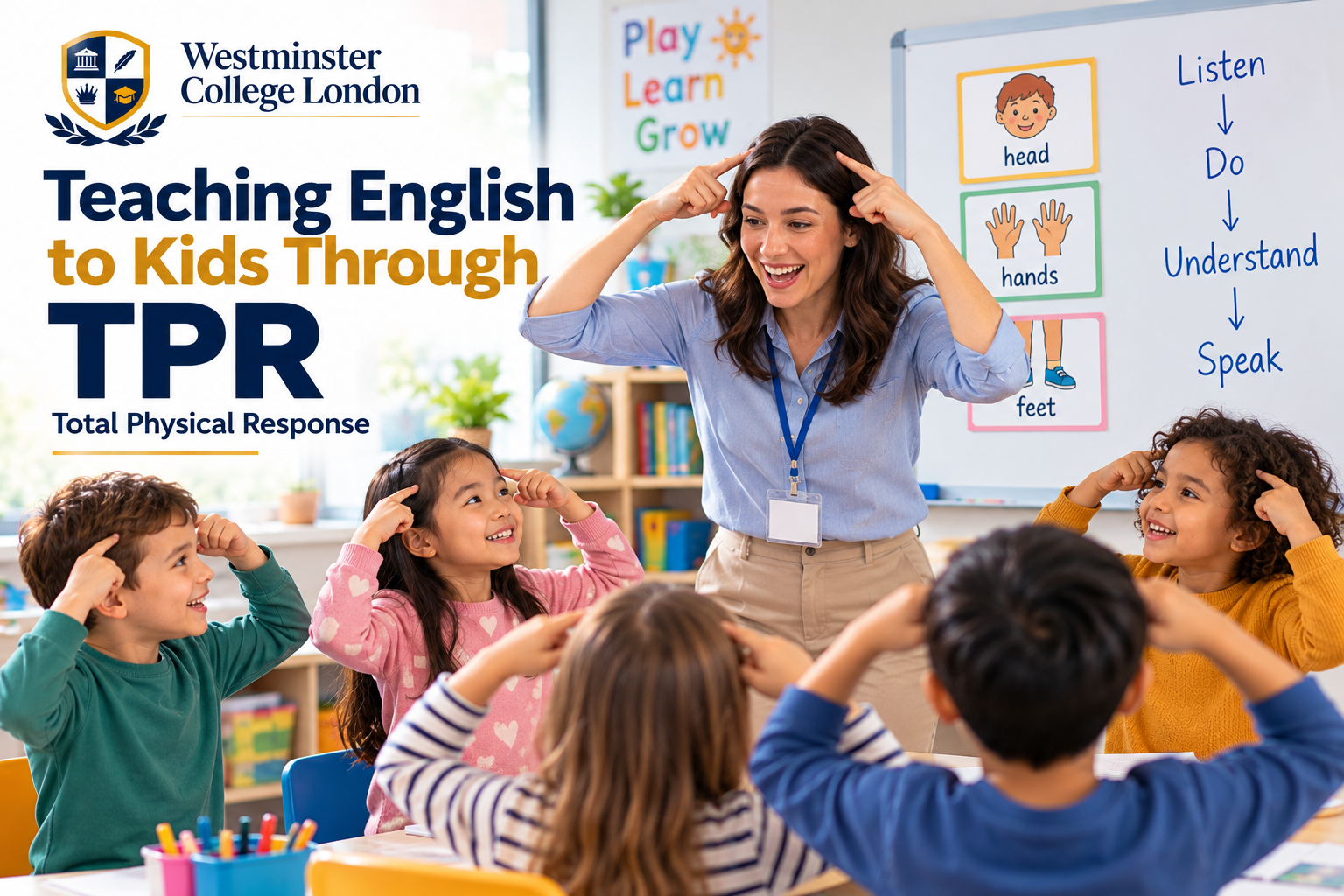
This is the basic principle behind Total Physical Response (TPR), a language teaching approach that connects spoken language with physical actions.
TPR can be particularly useful when teaching young learners because it allows children to demonstrate comprehension through movement before they are expected to produce spoken language independently.
In this article, Westminster College London explores how TPR works, why teachers use it, how to organise effective TPR activities, and how to incorporate movement-based learning into structured English lessons.
1. What Is Total Physical Response (TPR)?
Total Physical Response is a language teaching approach developed by psychologist James J. Asher.
The approach became widely known through Asher's research on second-language learning in the 1960s.
TPR focuses on developing listening comprehension through physical responses to spoken language.
Instead of beginning with grammar explanations or asking students to repeat unfamiliar sentences immediately, the teacher gives instructions accompanied by actions.
Students listen, observe, and respond physically.
For example:
Teacher: Stand up!
Students stand up.
Teacher: Sit down!
Students sit down.
Teacher: Touch your nose!
Students touch their noses.
Teacher: Point to the window!
Students point to the window.
Over time, the teacher gradually reduces the demonstrations so that learners must understand the spoken instructions independently.
As students become familiar with the language, they may begin giving instructions to classmates, describing actions, or participating in short conversations.
The Basic TPR Sequence
Listen → Observe → Act → Understand → Respond → Speak
This sequence is a practical teaching framework rather than a rigid developmental rule. Not every learner progresses at the same speed, and speaking opportunities should be introduced when appropriate.
The central principle is simple:
Children can demonstrate their understanding of language before they are ready to produce it independently.
2. Why Is TPR Useful for Teaching Children?
Young learners often respond positively to activities involving movement, gestures, visual materials, and meaningful interaction.
Traditional approaches based primarily on explanations, translation, and written exercises may be unsuitable for children who are still developing literacy skills.
TPR provides several potential advantages.
A. It Makes Meaning Easier to Understand
When teachers connect language with visible actions, students receive clues about what words and expressions mean.
For example, instead of translating jump, the teacher jumps while saying the word.
Learners can associate the spoken word with the action.
This is particularly useful when teaching concrete vocabulary.
B. It Reduces the Need for Immediate Speaking
Some children hesitate to speak English because they are unfamiliar with the language or afraid of making mistakes.
TPR allows them to participate without being required to speak immediately.
A child can show understanding by pointing, touching, moving, or selecting an object.
Teachers should still gradually provide opportunities for spoken production rather than treating silent participation as the final learning objective.
C. It Creates Opportunities for Active Participation
In a traditional question-and-answer activity, one learner may respond while others listen.
During a TPR activity, many students can respond simultaneously.
For example, when the teacher says, "Put your hands on your head," the entire class can demonstrate comprehension.
D. It Supports Attention and Lesson Variety
Brief movement activities can change the pace of a lesson and provide a break from prolonged sitting.
Teachers can use TPR to introduce language, recycle vocabulary, energise learners, or transition between classroom stages.
E. It Provides Immediate Evidence of Understanding
Physical responses allow teachers to observe whether learners understand an instruction.
If several students touch their ears when the teacher says "Touch your nose," further modelling or practice may be needed.
However, physical responses should be interpreted carefully. Some children may copy their classmates without fully understanding the language.
For this reason, teachers should gradually remove visual prompts and vary their instructions.
3. How to Teach English Through TPR: A Step-by-Step Method
Effective TPR lessons require careful planning. Simply asking children to jump, run, or clap repeatedly is not enough.
The actions must serve clear language learning objectives.
Step 1: Select the Target Language
Choose a small number of words or expressions suitable for your learners.
For an introductory lesson, you might select:
-
Stand up
-
Sit down
-
Clap your hands
-
Touch your head
-
Turn around
Avoid introducing too many new instructions at once.
The number of expressions should depend on students' age, familiarity with English, and ability to follow the activities.
Step 2: Establish Meaning Through Demonstration
Stand where all students can see you.
Say, "Stand up," and stand up.
Repeat the instruction while demonstrating the movement.
Invite students to copy you.
Use a clear voice and natural pace, and repeat the instruction as needed.
Step 3: Practise Through Teacher-Led Actions
Give familiar instructions while performing the actions yourself.
For example:
Teacher: "Clap your hands!"
Students clap.
Teacher: "Touch your head!"
Students touch their heads.
Teacher: "Turn around!"
Students turn around.
This stage helps learners connect sounds with actions.
Step 4: Remove the Demonstration
Once students appear familiar with the instructions, stop performing the actions.
Say, "Touch your head," while keeping your hands still.
Observe whether students respond correctly.
At this stage, children are relying more on their listening comprehension.
Step 5: Change the Sequence
Avoid giving instructions in exactly the same order.
If the sequence is always:
Stand up → Clap → Jump → Sit down
Students may simply memorise the routine.
Instead, vary the order:
"Clap your hands!"
"Sit down!"
"Stand up!"
"Touch your head!"
"Clap your hands!"
This helps distinguish genuine comprehension from memorised movement patterns.
Step 6: Introduce Student-Led Instructions
When learners are confident, invite them to give commands.
One student may say, "Touch your nose," while classmates perform the action.
Another might say, "Open your book."
This creates a bridge from listening comprehension to spoken language production.
Step 7: Connect Actions with Other Language Skills
TPR should not remain limited to movement.
After students understand and use the language, teachers can introduce reading and writing activities appropriate to their age and literacy level.
For example:
Students read Jump on a flashcard and perform the action.
Later, they match the word to a picture, complete a sentence, or write a short instruction.
4. Ten Practical TPR Activities for Young English Learners
Activity 1: Simon Says
Age group: Approximately 5–12 years
Language focus: Action verbs, body parts, and listening comprehension
Simon Says is one of the most familiar activities associated with TPR.
Procedure:
-
Introduce several commands through demonstration.
-
Explain that students should act only when the teacher begins with "Simon says."
-
Give a mixture of commands with and without the phrase.
-
Observe students' responses.
-
Gradually increase the complexity of the instructions.
Example:
Teacher: "Simon says, touch your nose!"
Students touch their noses.
Teacher: "Simon says, clap your hands!"
Students clap.
Teacher: "Jump!"
Students remain still.
Rather than eliminating students who make mistakes, allow them to continue playing so everyone receives repeated language practice.
Teaching tip: Begin slowly and increase the speed only when students understand the rules and vocabulary.
Activity 2: Teacher Says, Students Do
Age group: 4–9 years
Language focus: Classroom instructions
Choose five or six familiar classroom commands:
-
Open your book.
-
Close your book.
-
Pick up your pencil.
-
Put your pencil down.
-
Show me your notebook.
-
Point to the board.
Model each instruction before asking learners to respond independently.
Once students become familiar with the expressions, a student can take over the teacher's role.
Teaching tip: Recycle these expressions during regular lessons so that classroom instructions become meaningful everyday language.
Activity 3: Animal Actions
Age group: 4–10 years
Language focus: Animals and action verbs
Introduce animal vocabulary using pictures or toys.
For example:
-
Rabbit
-
Bird
-
Fish
-
Elephant
-
Cat
Associate each animal with an appropriate action.
Teacher: "Hop like a rabbit!"
Teacher: "Flap your arms like a bird!"
Teacher: "Swim like a fish!"
Teacher: "Walk like an elephant!"
Children demonstrate the movements.
After sufficient practice, show an animal picture and ask:
"What animal is it?"
Students can then describe actions using simple language:
"A rabbit can hop."
"A bird can fly."
Extension: Older children can write two or three sentences about an animal's abilities.
Activity 4: TPR with Prepositions
Age group: 6–12 years
Language focus: In, on, under, next to, behind, between
Use classroom objects such as books, pencils, and pencil cases.
Give instructions:
"Put your pencil on your book."
"Put your eraser under your notebook."
"Put your pen next to your pencil case."
Demonstrate each instruction initially.
Later, allow learners to perform the task independently.
Students can eventually take turns giving instructions to partners.
Extension: Ask children to describe where the objects are.
"The pencil is under the book."
Activity 5: Action Songs
Age group: 3–9 years
Language focus: Body parts, movements, and repeated expressions
Songs can provide opportunities for coordinated movement and language practice.
For example, teachers can use familiar classroom songs such as Head, Shoulders, Knees and Toes.
Before introducing the song, teach the body-part vocabulary through pictures or gestures.
During the song, children point to the relevant body parts.
Afterwards, check comprehension by giving instructions without the music.
"Touch your shoulders."
"Show me your knees."
"Point to your toes."
Teaching tip: Ensure that the song supports the target language rather than becoming an activity performed purely for entertainment.
Activity 6: Find and Touch
Age group: 4–10 years
Language focus: Colours, objects, and classroom vocabulary
Give simple instructions:
"Touch something blue."
"Point to a window."
"Find a book."
"Show me something red."
Children respond by touching, pointing, or showing the appropriate objects.
For safety, avoid asking students to run around the classroom or compete physically to reach objects first.
Extension: Students give similar instructions to their classmates.
Activity 7: The Action Story
Age group: 6–12 years
Language focus: Everyday actions, vocabulary, and listening comprehension
Create a short story containing familiar actions.
For example:
"Tom wakes up. He stretches his arms. He brushes his teeth. He washes his face. He puts on his shoes. He walks to school."
First, demonstrate the movements while telling the story.
Then repeat the story and encourage children to perform the actions.
Gradually reduce your modelling.
Extension: Use pictures to help students retell the story orally or write a short sequence of sentences.
Activity 8: TPR with Flashcards
Age group: 4–10 years
Language focus: Vocabulary recognition
Prepare flashcards showing actions such as:
-
Run
-
Walk
-
Sleep
-
Eat
-
Read
-
Write
Hold up a flashcard and model the action.
Then put the flashcards on the board.
Give instructions:
"Point to 'sleep'."
"Show me 'read'."
"Act out 'write'."
Once students recognise the actions, remove the visual support and give spoken commands.
Teaching tip: This activity also supports transitions towards recognising written words.
Activity 9: Student as Teacher
Age group: 6–12 years
Language focus: Giving instructions and speaking confidence
Invite one student to stand at the front of the classroom.
Provide a set of familiar instruction cards.
The student selects a card and gives a command.
For example:
"Stand up."
"Turn around."
"Clap your hands."
Classmates follow the instructions.
Rotate the role so different students have opportunities to speak.
For shy learners, allow them to give instructions to a partner before addressing the whole class.
Activity 10: TPR Treasure Hunt
Age group: 7–12 years
Language focus: Directions and prepositions
Place familiar objects in safe locations around the classroom.
Give instructions:
"Take three steps forward."
"Turn left."
"Look under the table."
"Find the blue card."
Students follow the directions to locate an object.
For larger classes, organise small groups with clearly defined roles.
Extension: Students write their own instructions for another group to follow.
5. A Complete 45-Minute TPR Lesson Plan
Lesson title: My Body and Actions
Age group: 6–8 years
English level: Beginner / Pre-A1
Duration: 45 minutes
Teaching approach: TPR supported by visual and oral activities
Learning Objectives
By the end of the lesson, most students should be able to:
-
Recognise five body-part words: head, shoulders, knees, toes, and hands.
-
Follow at least four familiar spoken instructions without teacher demonstration.
-
Say selected body-part words and simple commands.
-
Match body-part vocabulary to pictures.
Materials
-
Body-part flashcards
-
A picture of the human body
-
Whiteboard and markers
-
An age-appropriate action song
-
Matching worksheet
-
Colouring pencils
Lesson Procedure
TimeStageActivities0–5 minWarm-upReview familiar commands: stand up, sit down, clap, turn around5–12 minVocabulary introductionIntroduce body parts with flashcards, modelling, and pronunciation practice12–20 minTPR practiceStudents follow instructions such as "Touch your head" and "Show me your hands"20–27 minAction songStudents perform actions while listening to the song27–35 minTPR gamePlay an inclusive version of Simon Says using target vocabulary35–41 minReading and matchingStudents match body-part words or pictures to the correct parts41–45 minReview and assessmentCheck comprehension individually or in small groups; assign simple homework
Detailed Teaching Instructions
Warm-up: Minutes 0–5
Greet students and review previously taught classroom instructions.
Begin slowly and model each action once.
Then give instructions without modelling.
Praise participation and provide help when needed.
Vocabulary Introduction: Minutes 5–12
Show a picture of a head.
Say, "Head."
Ask students to repeat the word.
Point to your head.
Repeat with shoulders, knees, toes, and hands.
Check understanding through pointing and selection tasks.
TPR Practice: Minutes 12–20
Model simple commands:
"Touch your head."
"Touch your shoulders."
"Show me your hands."
After several repetitions, stop demonstrating.
Vary the instructions and observe individual learners.
Action Song: Minutes 20–27
Play the selected song.
Perform the relevant movements with the students.
Repeat the song if learners remain engaged.
Follow the music activity with a short listening check without visual support.
TPR Game: Minutes 27–35
Introduce Simon Says.
Demonstrate the difference between commands beginning with "Simon says" and those without it.
Allow all learners to continue participating even when they make mistakes.
Reading and Matching: Minutes 35–41
Give students a body-parts worksheet.
Ask them to match pictures or labels.
Children who are not yet ready to read the words can match spoken instructions to pictures or complete a colouring task.
Assessment: Minutes 41–45
Give a small number of instructions to individuals or groups without gestures.
For example:
"Touch your knees."
"Show me your hands."
"Touch your shoulders."
Check whether students understand independently.
Homework: Draw a person and label the five body parts, or complete an age-appropriate picture-matching activity.
Assessment Checklist
Learning outcomeNot yetWith supportIndependentlyRecognises five body-part words☐☐☐Follows familiar commands☐☐☐Responds without teacher gestures☐☐☐Says selected words or commands☐☐☐Matches vocabulary to pictures☐☐☐
Teachers can use the results to decide which vocabulary needs to be recycled in the next lesson.
6. How to Use TPR with Different Age Groups
Not all children respond to the same teaching activities in the same way.
Teachers should adapt TPR to learners' developmental abilities, interests, language proficiency, and physical needs.
Ages 3–5: Very Young Learners
Use short, highly visual activities.
Focus on:
-
Simple movements
-
Body parts
-
Animals
-
Colours
-
Toys
-
Classroom routines
Keep movement activities brief and alternate them with quieter tasks.
Children in this age group may still be developing balance and motor coordination, so avoid movements that are physically difficult or unsafe.
Ages 6–8: Early Primary Learners
Introduce more combinations of instructions.
For example:
"Pick up your pencil and put it on the desk."
"Touch your head and clap twice."
Activities can include games, songs, stories, and flashcard practice.
Begin connecting spoken language with written words where developmentally appropriate.
Ages 9–12: Older Primary Learners
Use more complex language and purposeful tasks.
For example:
"Walk to the board, choose a picture of an animal, and describe what it can do."
Older students can also create instructions, lead activities, and write short descriptions.
Avoid relying exclusively on games designed for preschool learners, as these may feel too childish for some students.
7. How Can TPR Be Used to Teach Grammar?
TPR is not limited to individual action verbs.
Teachers can use movement-based tasks to illustrate selected grammatical structures.
Teaching Imperatives
Target language:
-
Stand up.
-
Close the door.
-
Pick up your bag.
-
Don't touch the table.
Students respond physically to positive and negative commands.
Teaching the Present Continuous
Teacher demonstrates an action.
Teacher: "I am jumping."
Students observe.
Then a student performs an action.
Teacher: "What is Sara doing?"
Students: "She is jumping."
This moves beyond pure TPR into guided speaking practice.
Teaching Prepositions
Use objects and classroom furniture to illustrate:
-
On
-
Under
-
Behind
-
Between
-
Next to
Students follow instructions and later describe object locations.
Teaching Ability with Can
Teacher: "Can a bird fly?"
Students respond orally or using a gesture.
Teacher: "Show me how a bird flies."
Students imitate the movement.
Extend the activity with simple sentences:
"A bird can fly."
"A fish can swim."
Teachers should ensure that the movements represent the intended meaning accurately. TPR is generally more suitable for concrete, observable language than highly abstract grammar concepts.
8. Combining TPR with Speaking, Reading, and Writing
One limitation of using TPR alone is that students may become skilled at following commands without developing sufficient independent speaking or writing ability.
For this reason, teachers should combine TPR with other language teaching techniques.
TPR and Speaking
After demonstrating and responding to actions, students begin giving instructions to classmates.
They may progress towards descriptions such as:
"He is running."
"She is reading."
"The cat is sleeping."
TPR and Reading
Introduce flashcards containing written instructions.
Students read the instruction and perform the corresponding action.
For example:
Open your book.
Touch your nose.
Stand up.
This helps connect familiar spoken language with print.
TPR and Writing
Begin with short written tasks appropriate to learners' literacy development.
For example:
-
Match words to actions.
-
Complete missing letters.
-
Write action verbs.
-
Write short instructions.
-
Describe what a classmate is doing.
TPR and Storytelling
Tell a story while children perform relevant actions.
Then encourage learners to sequence pictures, retell the story, or write simple sentences about the events.
The key is to use physical response as a starting point for broader language development, not as a replacement for other essential skills.
9. Common Mistakes Teachers Make When Using TPR
Mistake 1: Giving Too Many Instructions
Introducing 15 unfamiliar commands in one activity can overwhelm beginners.
Better approach: Select a manageable number of expressions and recycle them through several activities.
Mistake 2: Making Students Repeat Without Checking Understanding
Students may imitate the teacher's movements without understanding the spoken language.
Better approach: Gradually remove demonstrations and change the order of instructions.
Mistake 3: Using TPR Only as Entertainment
A movement game may be enjoyable without producing meaningful language learning.
Better approach: Identify the specific vocabulary, expressions, or listening skills that the activity should develop.
Mistake 4: Keeping Students Moving for Too Long
Long periods of physical activity can become tiring or overstimulating.
Better approach: Alternate active tasks with calmer activities such as matching, drawing, listening, or storytelling.
Mistake 5: Ignoring Individual Learner Needs
Not all children can or want to perform the same movements.
Better approach: Provide inclusive alternatives such as pointing, moving a picture, selecting a flashcard, using hand gestures, or directing a partner.
Never require physically unsafe or uncomfortable actions.
Mistake 6: Failing to Develop Spoken Language
If learners only respond to commands, their ability to use language independently may remain limited.
Better approach: Introduce student-led commands, pair interaction, description, and meaningful communication when students are ready.
Mistake 7: Using TPR for Every Teaching Objective
Movement is not equally suitable for every aspect of English.
For example, abstract concepts, extended writing, and complex discussions may require different methods.
Better approach: Combine TPR with communicative language teaching, storytelling, phonics, guided reading, and writing instruction.
10. How to Manage a TPR Classroom Effectively
Movement-based learning can be energetic, but it should not become uncontrolled.
Teachers need clear routines and safety expectations.
Establish a Start-and-Stop Signal
Before beginning, teach a simple attention signal.
For example:
Teacher: "Freeze!"
Students stop moving.
Practise the signal before starting games.
Define Movement Boundaries
Explain where students may move and which areas should remain clear.
Remove obstacles and ensure that activities suit the available classroom space.
Avoid Unnecessary Competition
Games that eliminate learners or reward only the fastest students may reduce participation.
Prefer cooperative games that allow everyone to practise.
Use Clear Instructions
Do not talk continuously while children are moving.
Gain attention, demonstrate the task, check understanding, and then start.
Include Quieter Learners
Use whole-class and small-group responses before asking individual students to perform in front of everyone.
Plan Transitions
Move from active tasks to calm activities with a predictable routine.
For example:
"Stop."
"Take a deep breath."
"Sit down."
"Open your book."
Good classroom management makes TPR more productive and easier to integrate into regular lessons.
11. How to Assess Learning Through TPR
Assessment should focus on students' understanding and use of the target language rather than how enthusiastically they perform.
Teachers can observe several areas.
Listening comprehension: Can the learner follow familiar commands without gestures?
Vocabulary recognition: Can the learner identify the correct object, picture, or action?
Retention: Can the learner respond to previously taught language in a later lesson?
Speaking development: Can the learner independently give simple instructions or describe actions?
Transfer: Can the learner understand the same vocabulary when it appears in a new activity or context?
A teacher might record performance using three simple categories:
-
Not yet demonstrated
-
Demonstrated with support
-
Demonstrated independently
For example, a student who follows Put your pencil under the book without watching classmates may demonstrate stronger independent comprehension than one who responds only by copying others.
Teachers should repeat assessment opportunities across lessons rather than making decisions based on a single performance.
12. The Limitations of Total Physical Response
Although TPR can be valuable, it is not a complete language teaching methodology for every learning objective.
Some limitations should be considered.
Not all vocabulary is easy to demonstrate. Abstract words such as freedom, responsibility, or although cannot always be communicated clearly through actions.
Physical responses do not guarantee complete understanding. Learners may imitate classmates or respond to familiar routines.
Some students may dislike performing actions publicly. Teachers should provide alternative ways to participate.
Repetition can become monotonous. Using the same commands and games too frequently may reduce engagement.
TPR does not automatically develop independent communication. Teachers must introduce opportunities to speak, interact, read, and write.
The British Council also recommends integrating TPR with other classroom approaches and techniques.
The most effective use of TPR is therefore usually as one component of a balanced English language programme.
13. Professional Development: Learning to Use TPR Effectively
Knowing how to demonstrate an action is only a small part of effective TPR teaching.
Professional teachers need to understand how to choose appropriate language, sequence activities, monitor comprehension, support different learners, and connect physical responses with broader language outcomes.
Teacher training can help educators answer important questions:
-
Which vocabulary is suitable for TPR?
-
How many new expressions should be introduced?
-
When should teacher demonstrations be reduced?
-
How can TPR be adapted for different age groups?
-
How can teachers distinguish comprehension from imitation?
-
When should students move from listening to speaking?
-
How should TPR be integrated with reading and writing?
At Westminster College London, our TEFL and TESOL teacher-training programmes help aspiring and practising teachers develop knowledge of language teaching methodology, lesson planning, young learner instruction, classroom management, and assessment.
These areas are essential for teachers who want to move beyond entertaining activities and design lessons with clear learning objectives.
Explore our professional teacher-training programmes:
Website: https://westminstercollege.uk
Email: info@westminstercollege.uk
Conclusion
Teaching English to children requires more than introducing vocabulary, explaining grammar, or completing exercises in a coursebook.
Young learners need meaningful exposure to language, appropriate opportunities to participate, and activities suited to their developmental needs.
Total Physical Response offers a practical way to connect spoken English with observable actions.
Through classroom instructions, movement games, stories, songs, and student-led activities, teachers can help children develop listening comprehension and begin using English in meaningful contexts.
However, successful TPR teaching involves more than keeping children physically active.
Teachers must select clear language objectives, model instructions carefully, check independent comprehension, adapt activities to individual needs, and gradually connect movement with speaking, reading, and writing.
The aim is not simply to make children move. It is to help them understand and use English.
At Westminster College London, we believe effective teaching combines professional knowledge, practical classroom skills, creativity, and continuous reflection.
When carefully planned and appropriately integrated with other teaching approaches, TPR can become a valuable part of a young learner's English learning experience.
References and Further Reading
-
Asher, J. J. (1969). The Total Physical Response Approach to Second Language Learning. The Modern Language Journal, 53(1), 3–17. https://doi.org/10.1111/j.1540-4781.1969.tb04552.x
-
British Council TeachingEnglish. Total Physical Response – TPR. https://www.teachingenglish.org.uk/professional-development/teachers/managing-lesson/total-physical-response-tpr
-
British Council TeachingEnglish. TPR – Teaching Knowledge Database. https://www.teachingenglish.org.uk/professional-development/teachers/teaching-knowledge-database/t-w/tpr
-
British Council. Five Essential Tips for Teaching Very Young Children English. https://www.britishcouncil.org/voices-magazine/five-essential-tips-teaching-very-young-children-english