
Introduction
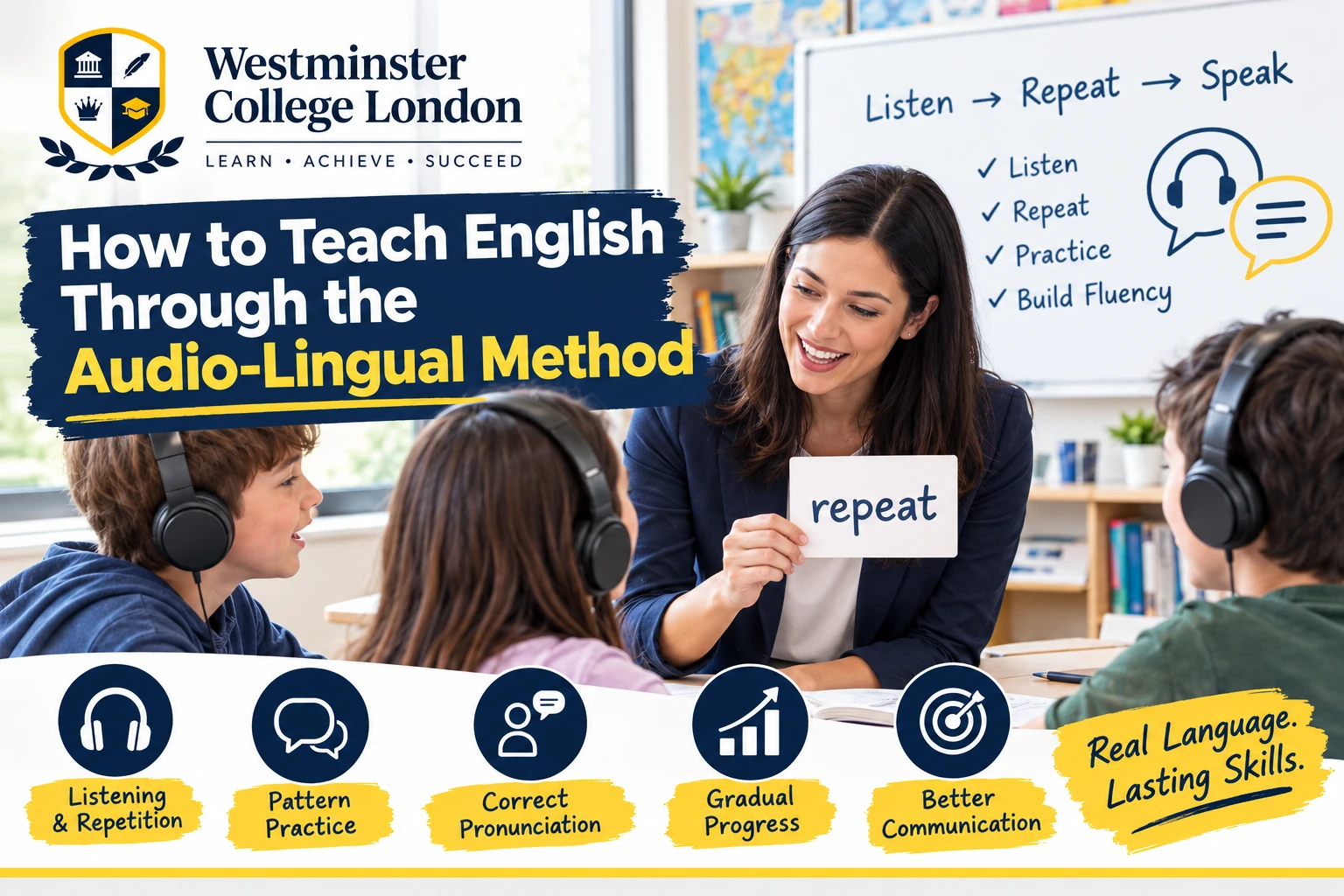
The Audio-Lingual Method (ALM) is a language-teaching approach that places strong emphasis on listening, speaking, repetition, drilling, and the formation of accurate language habits. It became particularly influential in the mid-20th century and was strongly influenced by behaviourist theories of learning and structural views of language.
In an Audio-Lingual classroom, learners hear a model of the target language, practise it repeatedly, and gradually develop the ability to produce the structure accurately and automatically.
The method is particularly useful when a teacher wants learners to develop accurate pronunciation, sentence patterns, grammatical accuracy, and oral fluency through controlled practice.
What Is the Audio-Lingual Method?
The Audio-Lingual Method teaches language primarily through oral practice before extensive written analysis.
Instead of beginning with a grammar explanation, the teacher normally:
-
Presents a language model.
-
Learners listen carefully.
-
Learners repeat the model.
-
The teacher uses drills to practise the structure.
-
Learners manipulate the structure in controlled ways.
-
The teacher gradually introduces variations.
-
Learners eventually use the structure more independently.
For example, instead of explaining the past tense first, the teacher might model:
Teacher: "I went to London yesterday."
Students: "I went to London yesterday."
The teacher can then introduce substitutions:
Teacher: "Paris."
Students: "I went to Paris yesterday."
Teacher: "Manchester."
Students: "I went to Manchester yesterday."
The learners practise the grammatical pattern repeatedly before being asked to use it more freely.
Why Use the Audio-Lingual Method?
There are several reasons a teacher may choose Audio-Lingual techniques.
1. To improve pronunciation
Repeated oral practice gives learners opportunities to hear and reproduce sounds, stress, rhythm and intonation.
This can be particularly useful for learners whose first language has significantly different sound patterns from English.
2. To develop automaticity
One important goal is to help learners produce common structures without having to consciously construct every sentence.
For example, repeated practice with:
"Would you like...?"
can help learners eventually produce the expression naturally when making offers.
3. To practise grammatical patterns
ALM can give learners extensive controlled practice with structures such as:
-
present and past tenses
-
questions
-
negatives
-
modal verbs
-
conditionals
-
reported speech
-
common sentence patterns
4. To build confidence
Some learners benefit from practising a structure several times before they are expected to use it independently.
Controlled practice can provide a relatively low-risk environment in which learners can become familiar with the language.
5. To develop listening and speaking skills
Because the method gives considerable attention to oral language, it can be useful when the immediate objective is accurate spoken production rather than written grammatical analysis.
When Should Teachers Use the Audio-Lingual Method?
The Audio-Lingual Method does not need to be used for an entire lesson. Many modern teachers use Audio-Lingual techniques as part of a broader communicative lesson.
It can be particularly useful:
When introducing a new language pattern
For example, when teaching:
"Have you ever...?"
The teacher can first establish the pattern through modelling and repetition.
When learners make persistent grammatical errors
If students repeatedly produce:
"He go to school every day."
the teacher can use controlled drills to practise:
"He goes to school every day."
before moving to freer communication.
When practising pronunciation
Short repetition and substitution drills can help learners focus on difficult sounds, stress or intonation.
With beginners
Beginners can benefit from predictable patterns and carefully controlled oral practice, particularly when they have limited vocabulary.
Before communicative activities
A teacher can use a short Audio-Lingual stage to give students the language they need before moving into a role-play, information gap or task.
Where Can the Audio-Lingual Method Be Used?
The method can be used in a variety of teaching environments.
Face-to-face classrooms
The teacher can model language and have the whole class, groups or individual learners respond.
Online classes
ALM works well in live online lessons because teachers can model expressions and students can repeat them through microphones.
Language laboratories
The method has historically been associated with language laboratories, where learners listen to recordings and practise spoken patterns.
Modern technology can provide similar opportunities through:
-
audio recordings
-
pronunciation platforms
-
learning management systems
-
interactive exercises
-
video conferencing
-
language-learning applications
One-to-one teaching
The teacher can provide highly personalised repetition and correction.
Large classes
Choral drills can allow many learners to practise a structure simultaneously, although individual checking should also be used to identify pronunciation or grammar problems.
How to Teach Through the Audio-Lingual Method
A practical Audio-Lingual lesson can follow these stages.
Step 1: Choose a Target Structure
Select one clear language pattern.
For example:
Target: Present continuous questions
"What are you doing?"
Possible responses:
"I'm reading."
"I'm studying."
"I'm watching TV."
The target should be appropriate for the learners' level.
Step 2: Present a Dialogue or Model
Introduce the target language through a short dialogue.
For example:
Teacher: What are you doing?
Student: I'm reading.
Teacher: What is your brother doing?
Student: He's watching TV.
The teacher first provides a clear oral model.
Step 3: Listening Practice
Before asking students to speak, allow them to listen.
The teacher can:
-
say the dialogue naturally
-
play an audio recording
-
repeat important sentences
-
ask learners to identify particular expressions
At this stage, learners focus primarily on hearing the language accurately.
Step 4: Choral Repetition
The teacher says a sentence and the whole class repeats it.
Teacher: "What are you doing?"
Class: "What are you doing?"
The teacher should listen for pronunciation, stress and intonation rather than simply encouraging mechanical repetition.
Step 5: Individual Repetition
After choral practice, ask individual learners to produce the same language.
Teacher: "What are you doing?"
Student: "What are you doing?"
This allows the teacher to identify individual problems that may be hidden during choral repetition.
Step 6: Use Substitution Drills
Substitution drills are one of the best-known Audio-Lingual techniques.
The teacher provides a cue and students replace one element of the sentence.
Model:
"I'm reading a book."
Teacher gives:
"newspaper"
Students produce:
"I'm reading a newspaper."
Teacher gives:
"magazine"
Students produce:
"I'm reading a magazine."
The teacher can gradually increase the difficulty.
Step 7: Use Question-and-Answer Drills
The teacher asks questions using the target structure.
Teacher: "Are you studying English?"
Students: "Yes, I'm studying English."
The teacher can then vary the cues:
"Is he working?"
"Are they playing football?"
"Is she watching television?"
The objective is to encourage rapid and accurate responses.
Step 8: Use Transformation Drills
Students transform one type of sentence into another.
Affirmative → Negative
Teacher:
"She is working."
Students:
"She isn't working."
Statement → Question
Teacher:
"They are playing football."
Students:
"Are they playing football?"
Present → Past
Teacher:
"I go to school."
Students:
"I went to school."
Transformation drills should be short and focused on one linguistic feature at a time.
Step 9: Use Chain Drills
A chain drill involves students asking and answering questions in sequence.
Student A:
"Where do you live?"
Student B:
"I live in London. Where do you live?"
Student C:
"I live in Bristol. Where do you live?"
This gives learners controlled opportunities to interact with one another.
Step 10: Move Towards Meaningful Communication
A modern teacher should not necessarily stop at repetition.
After sufficient controlled practice, learners should have an opportunity to use the language meaningfully.
For example, after practising:
"What did you do yesterday?"
students can interview classmates about their previous day.
The lesson therefore moves from:
Model → Repeat → Drill → Controlled production → Meaningful communication
This combination allows the teacher to retain the strengths of Audio-Lingual practice while addressing one of its major limitations: excessive mechanical repetition.
Example Audio-Lingual Lesson
Target language
"I have been to..."
Stage 1 – Model
Teacher:
"I have been to London."
Students listen.
Stage 2 – Repetition
Teacher:
"I have been to London."
Students repeat.
Stage 3 – Substitution
Teacher:
"Paris."
Students:
"I have been to Paris."
Teacher:
"Rome."
Students:
"I have been to Rome."
Stage 4 – Question and answer
Teacher:
"Have you been to Paris?"
Students:
"Yes, I have."
or
"No, I haven't."
Stage 5 – Individual practice
The teacher asks individual learners questions.
Stage 6 – Communicative practice
Students interview three classmates about places they have visited.
This final stage allows learners to transfer the practised structure into genuine communication.
Common Audio-Lingual Drills
Teachers can use several types of drills.
DrillPurposeRepetition drillPractise accurate reproductionSubstitution drillPractise replacing language elementsQuestion-and-answer drillPractise rapid responsesTransformation drillPractise grammatical changesCompletion drillPractise completing patternsExpansion drillBuild longer sentencesReduction drillProduce shorter formsChain drillPractise controlled interactionMinimal-pair drillPractise sound contrastsAdvantages of the Audio-Lingual Method
The method can be particularly effective for:
-
pronunciation practice
-
developing accurate sentence patterns
-
reinforcing grammatical structures
-
building automaticity
-
practising common expressions
-
providing intensive oral practice
-
helping beginners establish basic patterns
-
preparing learners for more communicative activities
Limitations of the Audio-Lingual Method
Teachers should also understand its limitations.
Excessive drilling can become mechanical and repetitive, and learners may be able to produce a correct sentence without fully understanding when or why to use it.
The method may also provide limited opportunities for:
-
spontaneous communication
-
creative language use
-
extended speaking
-
learner autonomy
-
negotiation of meaning
-
authentic interaction
For this reason, modern ELT practice often uses Audio-Lingual techniques selectively rather than treating ALM as the only teaching approach.
A Modern Approach to Using Audio-Lingual Techniques
A practical contemporary lesson might combine Audio-Lingual practice with communicative methodology:
1. Context
Introduce the target language in a meaningful situation.
2. Model
Teacher provides a clear pronunciation and grammar model.
3. Listen
Students listen for the target language.
4. Repeat
Students practise the model.
5. Drill
Use substitution, transformation and question-and-answer drills.
6. Controlled practice
Students use the structure with limited choices.
7. Communicative practice
Students use the language to exchange real information.
8. Feedback
Teacher provides correction and clarification.
This approach preserves the useful features of Audio-Lingual teaching while giving learners opportunities to communicate rather than simply repeat.
Conclusion
The Audio-Lingual Method is particularly valuable when teachers need learners to hear, practise and accurately produce specific language patterns. Its strongest applications include pronunciation, controlled grammar practice, sentence formation and the development of automatic responses.
However, repetition should have a clear pedagogical purpose. Rather than using drills for their own sake, teachers can use them as a bridge from accurate controlled production to meaningful communication.
A well-designed lesson can therefore move from hearing → repeating → drilling → controlled production → communication, giving learners both accuracy and opportunities to use English meaningfully.