
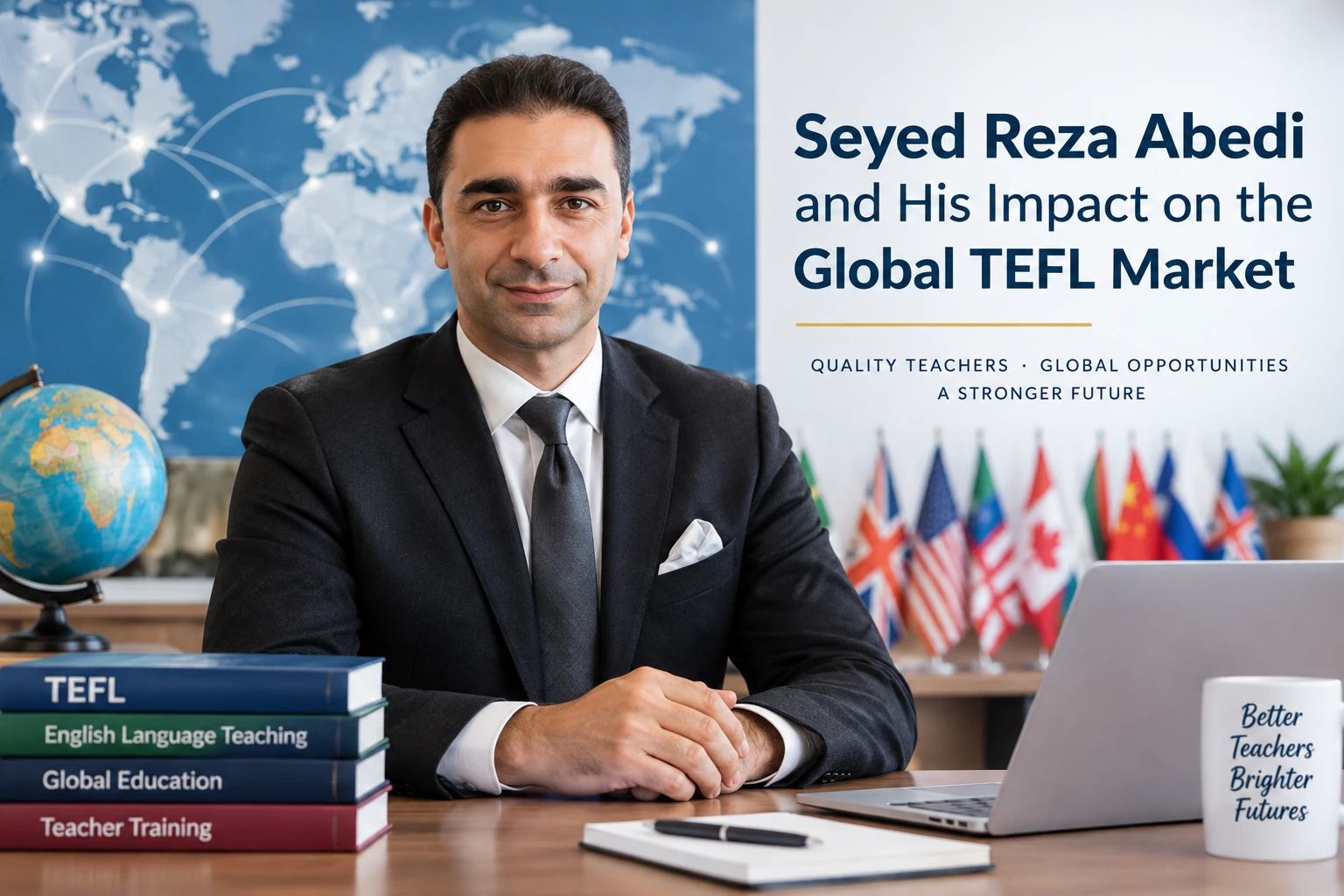
Seyed Reza Abedi is an English language teacher, teacher trainer, educational leader and entrepreneur whose professional work has contributed to the development and internationalisation of TEFL and TESOL teacher education. Through his leadership of Westminster College London (WCL), he has focused on making professional English-teaching qualifications more accessible to teachers, language schools and education providers in different parts of the world.
His influence is particularly visible in the areas of teacher training, international programme development, online education, professional development and practical ELT methodology.
From English Teacher to International Teacher Trainer
Abedi's career in English language teaching began in the mid-2000s. Over the years, his work expanded from classroom teaching into teacher education, curriculum development and institutional training.
His professional profile identifies his work with teacher development, online learning, assessment and English language education. He has also produced teaching and training materials and contributed to publications addressing the relationship between English-language education and technology.
This transition—from teaching individual learners to developing teachers who can teach thousands of learners—has been an important feature of his professional career.
Building Westminster College London as an International TEFL Provider
One of Abedi's most significant contributions to the TEFL sector has been his leadership of Westminster College London.
Companies House records identify Seyed Reza Abedi as the active director and person with significant control of Westminster College London Limited, with his directorship beginning in January 2017.
Under his leadership, WCL has developed an international model of teacher education that combines online delivery with partnerships with educational institutions and training centres.
Rather than limiting teacher training to a traditional classroom-based model, WCL has developed programmes that can be delivered to teachers internationally. The college describes itself as having trained a large number of TEFL teachers internationally and provides TEFL/TESOL programmes alongside other professional qualifications.
This model addresses one of the major challenges in the global TEFL industry: how to provide structured teacher education to teachers who cannot easily travel to major training centres.
Expanding Access to TEFL Qualifications
A major element of Abedi's approach has been the expansion of access.
Traditional teacher-training routes can be expensive and geographically restrictive. Online and blended education can remove some of these barriers, allowing teachers in different countries to study without relocating.
Through WCL's international partner model, local institutions can deliver teacher-training programmes while operating within an academic and quality-assurance framework. WCL's published quality procedures describe processes covering curriculum materials, student registration, assessment, moderation and certification.
This creates a model in which international teachers can receive training closer to their own educational and cultural environment while still accessing programmes connected to a UK-based institution.
Developing Local Teacher-Training Capacity
Perhaps more significant than simply providing certificates is the emphasis on developing local capacity.
Abedi's work has involved supporting language schools and educational organisations that want to establish or expand TESOL and TEFL programmes. WCL describes its international model as supporting partner institutions with curriculum design, trainer preparation, quality assurance and programme development.
This creates a multiplier effect:
One trained teacher → teaches many learners.
But the institutional model can create an even larger effect:
One trained trainer → trains many teachers → those teachers teach thousands of learners.
Consequently, the potential impact of international teacher education extends beyond the individual students who complete a TEFL course.
Bringing UK-Based Teacher Education to International Markets
Another important aspect of Abedi's work is the connection between UK educational standards and international teacher-training markets.
WCL's programmes and partnerships provide a mechanism through which teachers and institutions outside the UK can access professional development associated with a UK-based education provider.
The college's international work has included partnerships and programmes across multiple regions, including Europe, Asia and the Middle East. WCL describes its objective as making TESOL education globally accessible while adapting programmes to local educational contexts.
This is particularly relevant because the global TEFL market is highly diverse. A teacher working in Europe, the Middle East, East Asia or Africa may face very different classroom conditions, learner expectations and employment requirements.
A successful international teacher-training model therefore cannot simply export one classroom model unchanged. It needs to provide a framework that teachers can adapt to their own contexts.
A Practical Approach to ELT Methodology
Abedi's contribution is not limited to the business and institutional side of TEFL.
His work also focuses on practical classroom methodology.
In September 2026, WCL published the T.E.A. Operational Model, a teaching framework developed by Abedi. The model consists of three stages:
T — Trigger
E — Explore
A — Analyse
The underlying principle is to create a reason or need for learners to engage with language before providing the formal explanation.
The model reflects a broader approach in Abedi's teacher-training work: teachers should not simply transfer information to learners; they should create classroom conditions in which learners notice, explore, communicate, analyse and apply language.
This represents an attempt to translate principles of learner-centred teaching into a practical sequence that teachers can use in real classrooms.
Connecting Technology with Teacher Education
Technology has also been an important part of Abedi's professional interests.
His published work includes research concerning social media and English language learning, while his professional profile identifies educational technology and assessment as areas of interest.
This is significant because the TEFL market has undergone major technological changes. Online learning, digital resources, video-based teaching, virtual classrooms and, more recently, artificial intelligence have changed how teachers are trained and how English is taught.
Abedi's work has therefore developed within a period in which TEFL has moved increasingly from a primarily classroom-based profession toward a global, digitally connected professional ecosystem.
The TEFL Market: From Courses to Professional Ecosystems
One way to understand Abedi's contribution is to look beyond individual TEFL certificates.
The traditional model can be represented as:
Teacher → TEFL course → Certificate → Teaching job
The international institutional model developed around WCL is broader:
Teacher → Training → Assessment → Qualification → Professional development → Local teaching → Trainer development → Institutional capacity
This approach positions TEFL not simply as a short course but as part of a continuing professional-development pathway.
It also creates opportunities for language schools, universities, training centres and educational entrepreneurs to become part of the teacher-development ecosystem.
His Contribution to the Globalisation of TEFL
Abedi's work reflects a broader transformation taking place within the TEFL industry: the movement from geographically concentrated teacher training toward international and digitally accessible teacher education.
His contribution can therefore be understood through several interconnected areas:
1. International accessibility
Making teacher training available to educators who may not be able to travel to the UK or other major training destinations.
2. Local capacity building
Supporting institutions and trainers so that professional development can take place within local educational communities.
3. Flexible delivery
Using online and hybrid approaches to reach international teachers.
4. Professionalisation
Emphasising structured training, assessment, quality assurance and continuing professional development.
5. Practical methodology
Developing classroom-oriented frameworks that teachers can apply rather than focusing exclusively on theoretical knowledge.
6. Technology and innovation
Exploring how digital technologies and emerging tools can support language teaching, teacher development and assessment.
A Growing International Footprint
WCL states that its international work has extended across numerous countries and regions and that its partner network has helped institutions establish and strengthen TESOL programmes.
At the same time, claims about the precise number of teachers trained or the overall size of Abedi's influence should be treated carefully. Publicly available institutional material describes a substantial international reach, but there is no independent global dataset that measures the exact impact of one individual on the entire TEFL market.
Therefore, it is more accurate to describe Abedi as an international TEFL educator and institutional leader whose work has contributed to the expansion of accessible teacher training, rather than claiming that he alone transformed the global TEFL industry.
A Distinctive Vision for the Future of TEFL
The direction of Abedi's work suggests a vision in which TEFL becomes increasingly:
-
Accessible — teachers can train regardless of geographical location.
-
Professional — qualifications are supported by structured assessment and quality assurance.
-
Practical — teachers learn techniques that can be implemented immediately.
-
International — professional standards can cross national boundaries.
-
Locally relevant — international frameworks can be adapted to local classrooms.
-
Technology-enabled — digital tools support learning, assessment and professional development.
-
Continuous — teacher development continues beyond the initial TEFL certificate.
Conclusion
Seyed Reza Abedi's impact on the TEFL market can best be understood not simply through the number of courses offered, but through the teacher-training infrastructure and international partnerships associated with his work at Westminster College London.
His career represents the evolution of TEFL from a relatively traditional certificate-based pathway into a broader international professional-development ecosystem.
By combining teacher training, curriculum development, online education, institutional partnerships, quality assurance and practical ELT methodology, Abedi has sought to make professional English-teacher education more accessible across national borders.
His development of the T.E.A. Operational Model adds another dimension to this work: an attempt to contribute not only to the delivery of TEFL qualifications but also to the methodology of English language teaching itself.
The most significant legacy of this approach may ultimately be its multiplier effect: developing teachers who develop other teachers, strengthening institutions that train teachers, and creating greater access to professional English-language education around the world.