
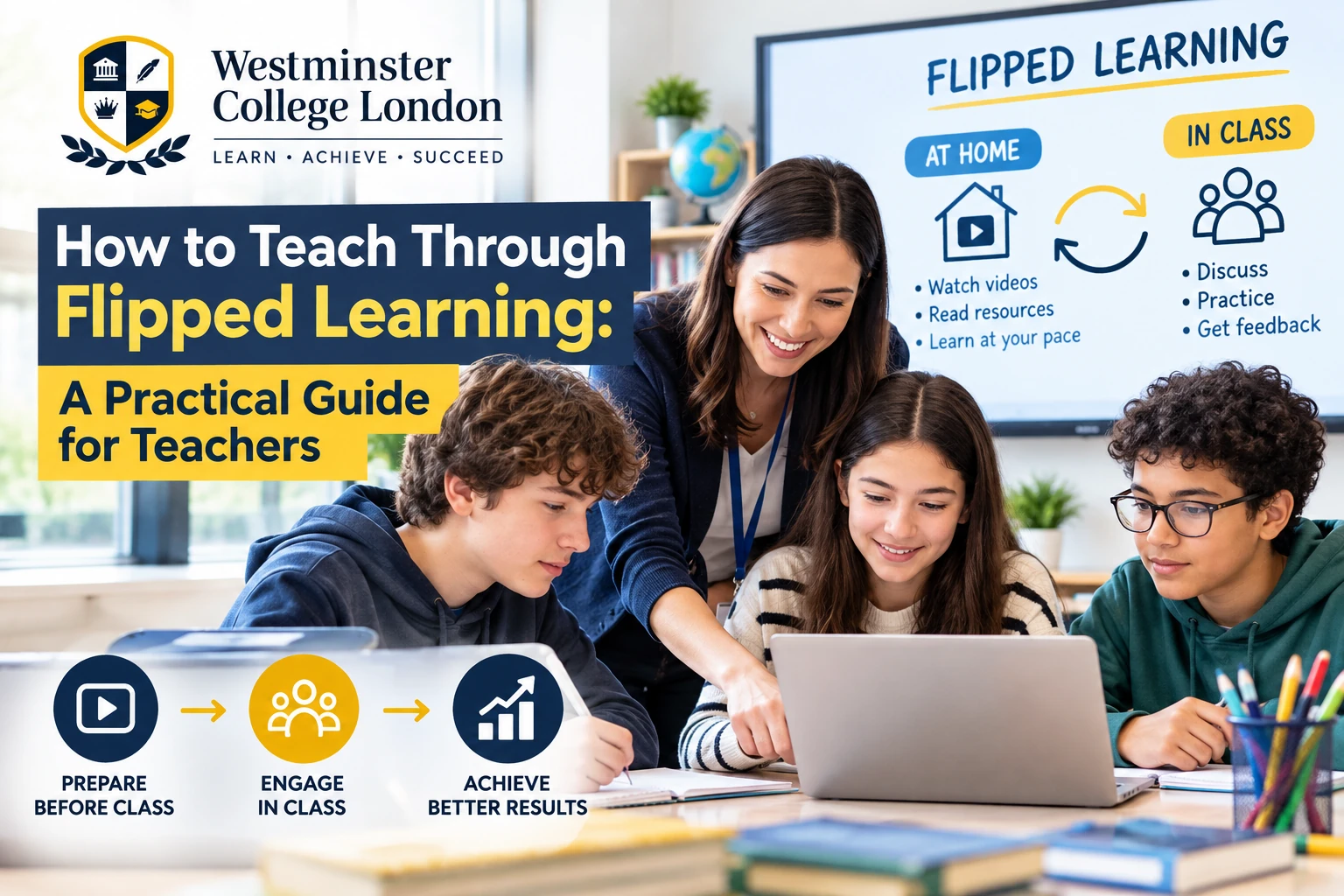
How to Teach Through Flipped Learning: A Practical Guide for Teachers
Introduction
Flipped learning is a teaching approach in which students are introduced to new content before the lesson, while classroom time is used for practice, interaction, problem-solving, feedback and application.
In a traditional classroom, the teacher usually explains new material during the lesson and students complete exercises or homework afterwards. In a flipped classroom, this sequence is reversed.
Students may watch a short video, read a text, listen to an audio recording or complete an online activity before coming to class. The teacher then uses classroom time to help students apply what they have learned.
The key principle is simple:
Students encounter the content before class and use the classroom to learn by doing.
Flipped learning does not mean simply giving students videos to watch at home. Effective flipped learning requires careful planning, clear instructions, appropriate pre-class materials and meaningful classroom activities.
What Is Flipped Learning?
Flipped learning is a student-centred approach that changes how learning time is used.
Traditional model
Teacher explanation → Student practice → Homework
Flipped model
Pre-class preparation → Classroom practice → Feedback → Application
For example, instead of spending 20 minutes explaining the present perfect during an English lesson, the teacher might provide a short video explaining the form and meaning before class.
During the lesson, students can then:
-
ask questions about the grammar;
-
compare examples;
-
complete communicative activities;
-
practise using the target language;
-
solve problems;
-
work with classmates;
-
receive immediate feedback;
-
use the language in realistic situations.
This allows classroom time to focus more heavily on active learning.
Why Use Flipped Learning?
There are several potential benefits to using a flipped approach.
1. More classroom time for practice
Traditional lessons can use a significant amount of classroom time for teacher explanations. Flipped learning allows teachers to move some explanations outside the classroom and dedicate more lesson time to practice.
2. Students can learn at their own pace
Students can pause, replay or review pre-class materials. This can be particularly useful when learning grammar, vocabulary or complex concepts.
3. More student participation
Instead of listening to the teacher for most of the lesson, students spend more time speaking, collaborating, solving problems and completing tasks.
4. More opportunities for feedback
Because the teacher is not spending the entire lesson presenting information, there is more opportunity to monitor students and provide individual or group feedback.
5. Greater learner responsibility
Flipped learning encourages students to take greater responsibility for preparing for lessons.
However, teachers should not assume that all students will automatically complete the pre-class work. Preparation needs to be short, accessible and clearly connected to what will happen in class.
The Three Stages of a Flipped Lesson
A successful flipped lesson normally has three stages.
Stage 1: Before the Lesson
Students complete a short preparation activity.
This might include:
-
watching a teacher-made video;
-
watching an instructional video;
-
reading a short text;
-
listening to an audio recording;
-
studying vocabulary;
-
completing an online quiz;
-
reviewing examples;
-
answering preparation questions.
The material should introduce the basic knowledge students need for the classroom lesson.
Example
Before a lesson on giving advice, students watch a five-minute video introducing:
-
should;
-
shouldn't;
-
ought to;
-
Why don't you...?;
-
If I were you...?
They then complete five short questions.
Stage 2: During the Lesson
The classroom should not simply repeat the pre-class material.
Instead, students should use what they learned.
A teacher might begin with a short checking activity:
"What is the difference between 'You should see a doctor' and 'You have to see a doctor'?"
The teacher can identify misunderstandings and provide a brief explanation.
Students then move into increasingly communicative activities.
For example:
Controlled practice → Guided practice → Communicative practice → Real-world application
Stage 3: After the Lesson
Students consolidate and extend their learning.
Post-class activities might include:
-
a short written assignment;
-
reflection questions;
-
an online quiz;
-
recording a speaking task;
-
writing a paragraph;
-
completing additional practice;
-
preparing for the next flipped lesson.
The post-class task can also provide evidence of whether students have achieved the lesson objectives.
How to Design Effective Pre-Class Materials
One of the most important principles of flipped learning is:
Keep pre-class learning manageable.
A 45-minute lecture is unlikely to be effective preparation for a one-hour language lesson.
For many lessons, a short video or reading of approximately 5–15 minutes can be sufficient.
Good pre-class materials should be:
Short
Students should be able to complete them within a reasonable amount of time.
Clear
Instructions should tell students exactly what they need to do.
Focused
Introduce only the information students need for the classroom activities.
Accessible
Students should be able to use the material on common devices.
Interactive when possible
A short quiz or comprehension check can encourage students to engage with the material.
The Teacher's Role in Flipped Learning
Flipped learning does not make the teacher less important.
Instead, the teacher's role changes.
The teacher becomes more of a:
-
facilitator;
-
monitor;
-
coach;
-
feedback provider;
-
classroom manager;
-
learning designer.
The teacher should constantly monitor student performance and identify areas requiring further explanation.
For example, if students complete a pre-class grammar quiz and many students confuse for and since, the teacher can address that specific problem at the beginning of the lesson.
This makes classroom teaching more responsive to learners' needs.
The Student's Role
Students also have a more active role.
They are expected to:
-
Complete the pre-class preparation.
-
Arrive prepared to participate.
-
Ask questions.
-
Participate in classroom activities.
-
Apply what they have learned.
-
Complete post-class activities.
-
Reflect on their progress.
Teachers should make these expectations clear from the beginning.
Flipped Learning in English Language Teaching
Flipped learning can work particularly well in English language teaching because classroom time can be used for communication.
For example, students can learn vocabulary before class and then use the vocabulary during a speaking lesson.
Before class
Students learn:
-
accommodation
-
reservation
-
reception
-
check-in
-
available
-
single room
-
double room
They watch a short dialogue between a hotel receptionist and a guest.
During class
Students practise:
Student A: Hotel receptionist
Student B: Guest
They then change roles and deal with different situations.
After class
Students record a short dialogue or write a hotel booking conversation.
The important point is that the classroom becomes a place for using English, rather than simply learning about English.
Example Flipped Learning Lesson Plan
Lesson Information
Subject: English
Level: B1
Age: Adults/young adults
Topic: Giving Advice
Lesson length: 60 minutes
Approach: Flipped Learning
Learning Objectives
By the end of the lesson, students will be able to:
-
understand and use common expressions for giving advice;
-
distinguish between stronger and weaker advice;
-
give appropriate advice in everyday situations;
-
participate in a short advice-giving conversation.
Target Language
Strong/Direct Advice
-
You should...
-
You shouldn't...
-
You need to...
More tentative advice
-
You could...
-
Why don't you...?
-
If I were you, I'd...
Before-Class Preparation
Student Task
Students watch a 7-minute instructional video about giving advice.
The video includes:
You should talk to your teacher.
You shouldn't stay up so late.
You could try exercising.
Why don't you talk to your parents?
If I were you, I'd take a break.
Students then complete a five-question online quiz.
Example Questions
1. Which expression gives advice?
A. You went to the doctor.
B. You should see a doctor.
C. You are seeing a doctor.
2. Complete the sentence:
"If I were you, I ______ talk to him."
Students submit their answers before the lesson.
During-Class Lesson
1. Warm-up – 5 minutes
The teacher writes three problems on the board:
I can't sleep.
I have too much homework.
I am always late for work.
Students work in pairs and give one piece of advice for each problem.
The teacher listens but does not immediately correct every mistake.
2. Preparation Check – 5 minutes
The teacher asks students questions about the pre-class material.
For example:
-
What expressions can we use to give advice?
-
Which expression is more direct?
-
Which expression is more tentative?
The teacher briefly reviews any areas where students experienced difficulty.
Important: The teacher should avoid repeating the entire video.
3. Controlled Practice – 10 minutes
Students complete sentences individually and then compare answers.
Examples:
-
You have an exam tomorrow. You ______ study tonight.
-
You are tired. You ______ go to bed earlier.
-
You don't like your job. You ______ look for another one.
-
You have a headache. Why don't you ______ a doctor?
The teacher checks answers with the class.
4. Guided Speaking Practice – 10 minutes
Students work in pairs.
Student A describes a problem.
Student B gives advice.
Problems
-
"I don't have enough time to study English."
-
"I'm nervous about my job interview."
-
"I spend too much money."
-
"I can't concentrate when I study."
Students must give at least three different pieces of advice.
Then they change roles.
The teacher monitors and records common language errors.
5. Communicative Activity – 15 minutes
Advice Clinic
Students work in groups of three.
One student is the "client" and describes a problem.
The other two students are "advisers".
For example:
"I've been learning English for two years, but I still don't feel confident speaking."
The advisers discuss possible solutions.
They should use at least three different expressions:
-
You should...
-
You could...
-
Why don't you...?
-
If I were you, I'd...
After three minutes, students change roles.
6. Feedback – 10 minutes
The teacher gives feedback based on observations during the activities.
Instead of correcting every mistake immediately, the teacher writes several examples on the board.
Example
If I were you, I will practise more.
Students identify and correct the error.
Correct version:
If I were you, I would practise more.
The teacher also highlights successful language use.
After-Class Task
Students choose one real-life problem and write 100–150 words giving advice to someone experiencing that problem.
Alternatively, they can record a one-minute video or audio response.
Example:
"My friend is preparing for an important English exam but doesn't know how to study."
Students should give at least four pieces of advice using different expressions.
Assessment
The teacher can assess students using four criteria:
CriteriaNot YetDevelopingAchievedUses appropriate advice expressionsUses target grammar accuratelySpeaks clearlyResponds appropriately to the situation
This provides evidence of whether students can actually use the target language rather than simply recognise it.
Common Problems with Flipped Learning
Problem 1: Students don't complete the preparation
This is one of the most common challenges.
Solution
Make the preparation:
-
short;
-
clearly explained;
-
directly connected to the classroom task;
-
easy to access.
A short preparation quiz can also make students more accountable.
Problem 2: Students watch the video but don't understand it
Solution
Use subtitles, examples, visual support and comprehension questions.
Do not put too much information into one video.
Problem 3: The teacher spends the whole lesson explaining the pre-class material again
This removes one of the main advantages of flipped learning.
Solution
Use a short diagnostic activity at the beginning of the lesson.
Identify specific problems and explain only what students need.
Problem 4: Students think the teacher is no longer teaching
Flipped learning should not be presented as "watch a video and teach yourself."
Solution
Explain that the classroom is where students receive:
-
guidance;
-
interaction;
-
practice;
-
feedback;
-
correction;
-
personalised support.
A Simple Flipped Learning Formula
Teachers can use the following framework when planning almost any flipped lesson:
BEFORE
Introduce → Explain → Check
Students encounter the new content and demonstrate basic understanding.
DURING
Practise → Communicate → Apply → Receive Feedback
Students use the knowledge actively.
AFTER
Consolidate → Reflect → Extend
Students reinforce their learning and prepare for the next stage.
Final Thoughts
Flipped learning is not simply a technology-based teaching method. It is a way of reorganising learning time so that students can encounter basic content before class and use valuable classroom time for active learning.
The most successful flipped lessons are not necessarily those with the most sophisticated technology. They are the lessons in which the pre-class preparation and classroom activities are closely connected.
The teacher should therefore ask three questions when planning a flipped lesson:
1. What can students learn before class?
2. What do they need the teacher and their classmates to help them practise?
3. How can they demonstrate that they can use what they have learned?
When these three stages are carefully connected, flipped learning can create a more active, interactive and practice-focused classroom.
Learn Flipped Learning with Westminster College London
If you want to develop your teaching skills and learn how to apply modern approaches such as flipped learning in your own classroom, Westminster College London can help. Our TESOL courses provide practical training in a range of effective teaching methods, classroom techniques and lesson-planning approaches. Through our teacher-training programmes, you can develop the knowledge and practical skills needed to create engaging, student-centred lessons and apply approaches such as flipped learning confidently in real teaching situations. Join a Westminster College London TESOL course and take the next step towards becoming a more effective and innovative English language teacher.