
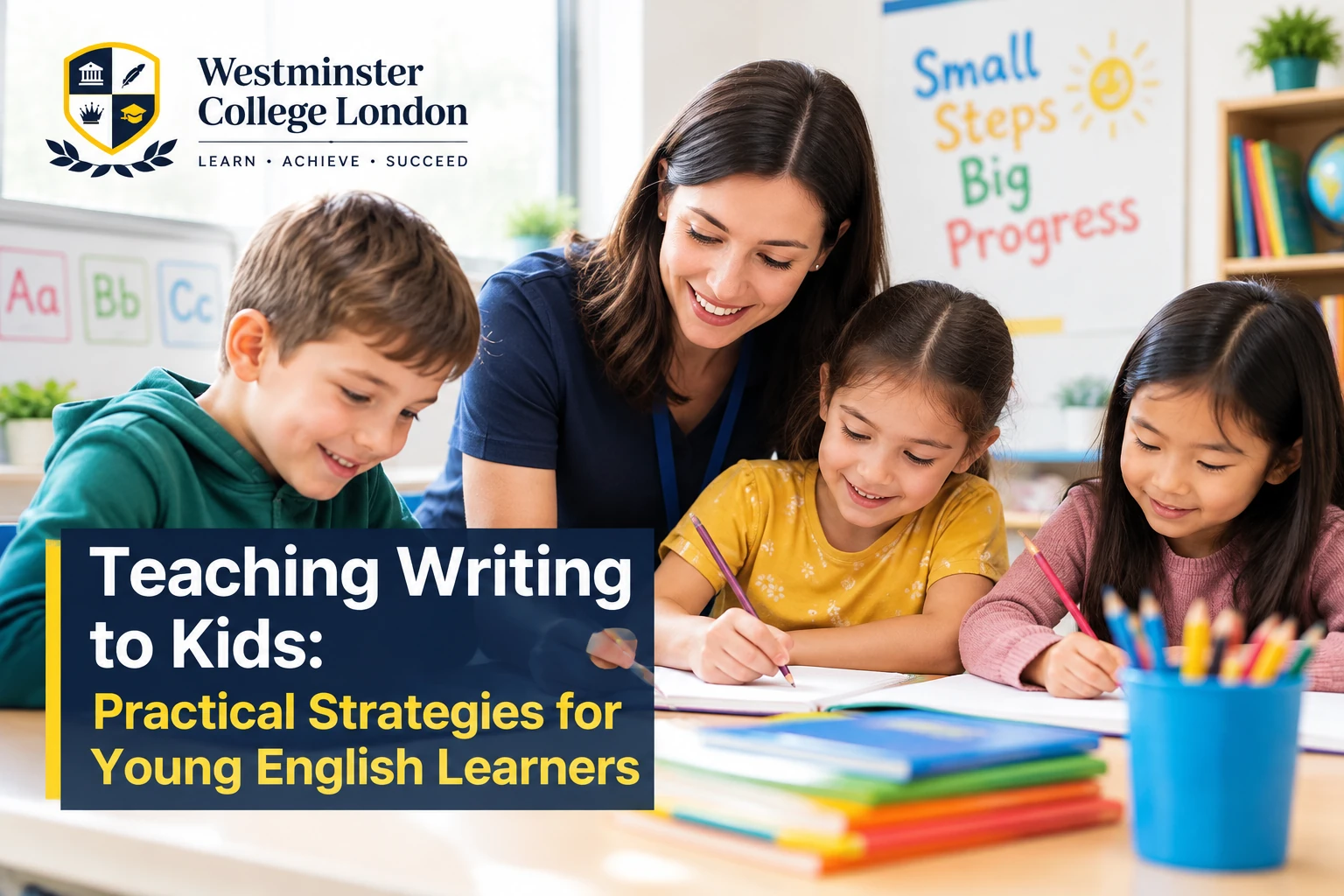
Teaching writing to children learning English can be both rewarding and challenging. Young learners need more than vocabulary and grammar knowledge to become confident writers. They need opportunities to develop ideas, experiment with language, organise their thoughts, and understand that writing is a way of communicating meaning.
For English teachers, the key is to make writing age-appropriate, purposeful, creative, and achievable.
This article explores practical strategies for teaching writing to kids and provides ideas that English teachers can use in the classroom.
Why Is Writing Important for Young English Learners?
Writing supports children's overall language development. When children write, they have an opportunity to practise vocabulary, grammar, spelling, sentence structure, and communication skills at the same time.
Writing can also help children:
-
Develop their creativity and imagination
-
Improve their vocabulary
-
Understand sentence structure
-
Reinforce grammar through meaningful use
-
Express their ideas and feelings
-
Develop critical thinking skills
-
Become more confident English users
-
Build skills needed for future academic writing
However, writing activities should reflect children's age, language level, interests, and attention span.
Start with Speaking Before Writing
One of the most effective ways to help children write in English is to give them an opportunity to talk before they write.
Young learners may have good ideas but lack the English vocabulary needed to express them on paper. Speaking activities can help them develop and organise those ideas first.
For example, before asking children to write about their favourite animal, the teacher could ask:
-
What animal do you like?
-
What does it look like?
-
Where does it live?
-
What does it eat?
-
Why do you like it?
The teacher can introduce useful vocabulary on the board and encourage students to discuss their ideas with a partner.
The writing task then becomes easier because learners already have ideas and language they can use.
Use Pictures as Writing Prompts
Pictures are particularly useful when teaching writing to children.
A picture gives learners something concrete to talk and write about. Teachers can use photographs, illustrations, cartoons, picture sequences, or classroom objects as prompts.
For example, show students a picture of a park and ask them to identify:
People → Places → Objects → Actions → Feelings
Students might produce language such as:
There is a boy in the park.
He is playing football.
His friends are watching him.
The weather is sunny.
Teachers can gradually move from individual sentences to short paragraphs.
Teach Writing in Small Steps
Asking a beginner child to "write a paragraph" can be overwhelming. Instead, teachers can break the task into manageable stages.
A simple progression might be:
Words → Phrases → Sentences → Connected Sentences → Short Paragraphs → Longer Texts
For example:
Words
dog – big – brown – park
↓
Phrase
a big brown dog
↓
Sentence
I saw a big brown dog.
↓
Connected sentences
I saw a big brown dog in the park. It was playing with a ball.
This approach allows children to experience success at every stage.
Give Children Useful Language
Young learners should not always be expected to create every sentence from scratch.
Providing sentence starters and language frames can give children the support they need.
For example, for a topic about holidays:
I went to ______.
I went with ______.
We visited ______.
My favourite part was ______ because ______.
As learners become more confident, teachers can gradually reduce this support.
This process is sometimes described as scaffolding. The teacher provides temporary support that helps learners complete a task they may not yet be able to complete independently.
Make Writing Meaningful
Children are generally more motivated to write when they have a real reason to write.
Instead of asking students simply to "write ten sentences", teachers can create communicative purposes.
For example:
-
Write a postcard to a friend.
-
Create a birthday invitation.
-
Write a message to a favourite character.
-
Make a class magazine.
-
Write a short story for younger students.
-
Create a menu for a restaurant.
-
Write instructions for a simple game.
-
Make a poster about an animal.
-
Write a review of a favourite book or film.
The purpose gives the writing task meaning and can increase engagement.
Use Creative Writing Activities
Creative writing can be particularly effective with children because it allows them to use their imagination.
Teachers can introduce simple story prompts such as:
One morning, I opened the door and saw...
Or:
When I looked under my bed, there was...
Students can then decide what happens next.
Teachers can also use story cards containing:
Character + Place + Object + Problem
For example:
A young explorer + a forest + a mysterious key + a lost treasure
Students use the four elements to create their own story.
The objective is not necessarily grammatical perfection. The activity should encourage children to communicate ideas and develop confidence as writers.
Teach Vocabulary Before the Writing Task
Vocabulary preparation can make writing considerably easier.
Before beginning a writing activity, teachers can introduce a small number of words that students are likely to need.
For example, before writing about a zoo:
Animals: elephant, lion, monkey, giraffe
Actions: eat, run, climb, sleep
Descriptions: big, small, dangerous, friendly
Students can then use the vocabulary to construct their own sentences.
Teachers should avoid introducing too many new words at once. A focused selection of useful vocabulary is usually more manageable for young learners.
Teach Children How to Organise Their Ideas
Writing is not only about producing correct sentences. Children also need to learn how to organise information.
Simple graphic organisers can help.
For example:
Beginning
Who? Where?
↓
Middle
What happens?
↓
Ending
How does the story finish?
For informational writing, teachers might use:
Topic → Facts → Examples → Conclusion
These structures help children understand that good writing has an organisation and purpose.
Encourage Drafting and Editing
Children should learn that good writing does not always happen in one attempt.
A simple writing process can be introduced:
Plan → Write → Check → Improve → Share
At a young age, editing should remain simple. Instead of correcting every error, teachers can ask students to check a few specific features:
-
Did I use capital letters?
-
Did I use full stops?
-
Did I spell the key words correctly?
-
Does my sentence make sense?
-
Did I include the information I wanted to communicate?
This makes editing manageable and helps children develop independence.
Don't Correct Every Mistake
Error correction requires careful consideration when teaching young learners.
If teachers correct every grammatical, spelling, and vocabulary error, children may become anxious about writing or focus more on avoiding mistakes than communicating ideas.
A more balanced approach is to select a small number of target areas.
For example, if the lesson objective is using past simple, the teacher can focus feedback primarily on past-tense verbs rather than correcting every aspect of the student's writing.
Feedback should help children understand what they did well and what they can improve next.
Use Pair and Group Writing
Writing does not always have to be an individual activity.
Collaborative writing can encourage children to share ideas and learn from each other.
For example, a teacher can give each group a series of pictures. Students work together to create a story and then write it as a group.
Another activity is shared story writing. The teacher starts the story with one sentence, and each student contributes another sentence.
Collaborative activities can make writing more social and less intimidating.
Technology and Digital Writing
Digital tools can also provide additional opportunities for young learners to write in English.
Children can create:
-
Digital stories
-
Online posters
-
Simple presentations
-
Class blogs
-
Digital books
-
Illustrated stories
Technology should support the language-learning objective rather than replace meaningful language practice.
The most important question is not whether a digital tool is being used, but whether children are using English to communicate, create, and develop their ideas.
Adapt Writing Tasks to Age and Level
There is no single writing activity that is appropriate for every child.
Very Young Beginners
Focus on:
-
Letter formation
-
Copying and tracing
-
Labelling pictures
-
Single words
-
Simple phrases
Elementary Learners
Focus on:
-
Basic sentences
-
Descriptions
-
Short messages
-
Simple stories
-
Personal information
Pre-Intermediate Learners
Focus on:
-
Paragraphs
-
Short narratives
-
Descriptions
-
Emails and messages
-
Opinions with simple reasons
As learners progress, teachers can gradually introduce more complex structures, longer texts, and greater independence.
Make Writing Enjoyable
Perhaps the most important principle is to make writing a positive experience.
Children are more likely to develop as writers when they have opportunities to write about things that interest them and when their work is valued.
Teachers can display students' writing in the classroom, create class books, organise story competitions, or allow learners to read their stories to classmates.
The goal is to help children see writing not simply as a school exercise, but as a way to communicate, create, imagine, and express themselves.
Final Thoughts
Teaching writing to children requires patience, careful scaffolding, and activities that match learners' developmental and language needs.
Effective young learner writing lessons often combine speaking, vocabulary development, visual support, guided practice, creativity, drafting, and feedback.
Rather than expecting children to produce perfect writing immediately, teachers can guide them through manageable stages and gradually increase their independence.
When children discover that they can use English to create their own stories, messages, descriptions, and ideas, writing becomes more than a language exercise—it becomes a meaningful form of communication.
Develop Your Skills as an English Language Teacher
Teachers who work with children need specialised knowledge of young learner development, classroom management, language teaching techniques, and age-appropriate activities.
Westminster College London provides professional teacher-training programmes designed to help English language teachers develop practical classroom skills and apply effective teaching approaches with learners of different ages and levels.