
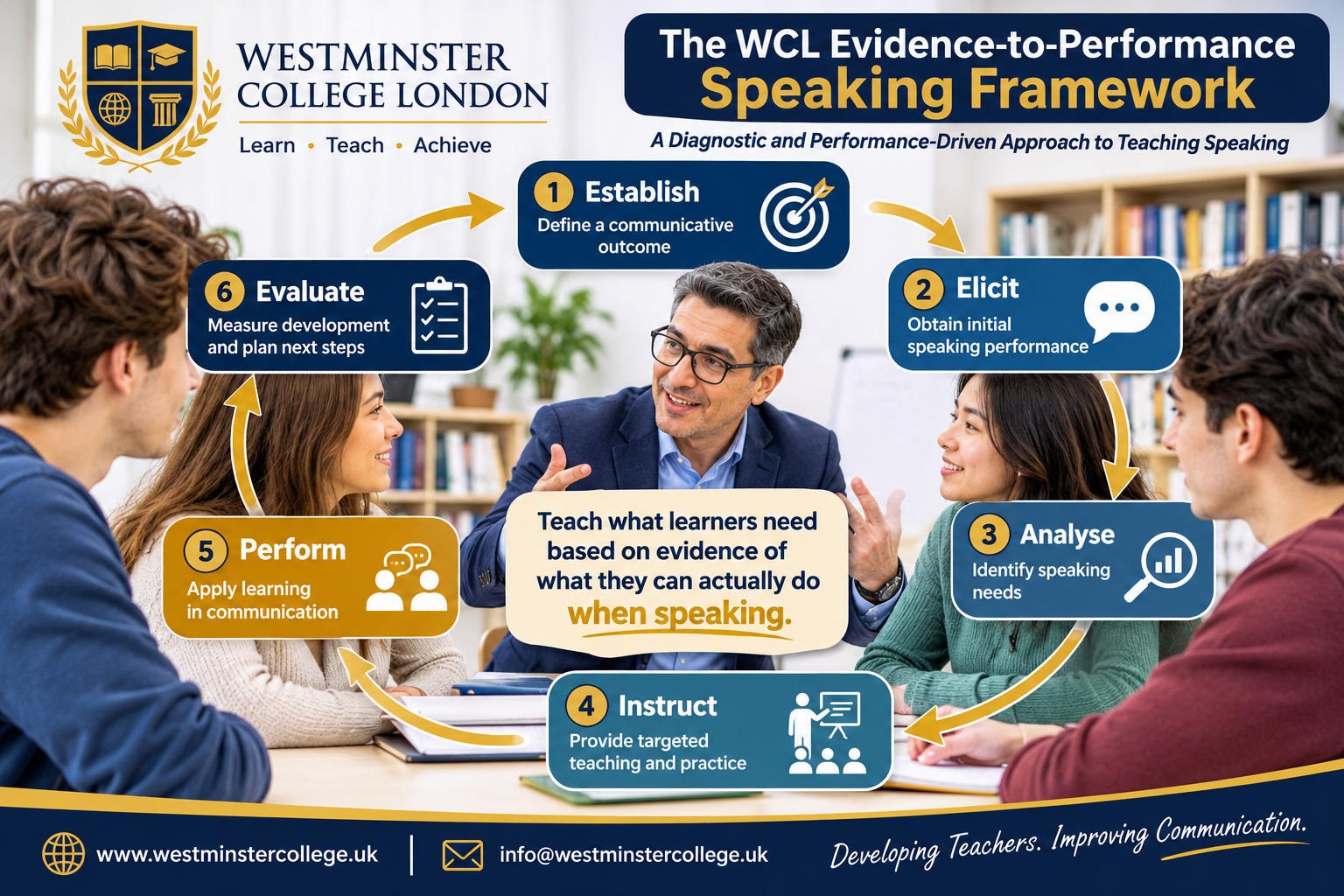
The WCL Evidence-to-Performance Speaking Framework: A Practical Approach to Teaching English Speaking
By Seyed Reza Abedi | Westminster College London
How do we know what our English learners actually need to improve their speaking?
A learner may understand grammar rules, recognise vocabulary and complete written exercises successfully, yet struggle to communicate confidently in a real conversation. Another learner may speak fluently but make frequent grammatical errors or have difficulty organising ideas.
These differences highlight an important question for English language teachers: should we teach speaking according to what we assume learners need, or according to what they demonstrate they can and cannot do?
At Westminster College London (WCL), we propose an approach that places learners’ actual speaking performance at the centre of instructional decisions.
The WCL Evidence-to-Performance Speaking Framework is based on one central principle:
Teach what learners need based on evidence of what they can actually do when speaking.
The framework provides teachers with a structured process for identifying speaking needs, planning targeted instruction, developing communicative performance and evaluating progress.
It is designed to help teachers move beyond simply presenting language and asking learners to practise it. Instead, teachers first observe learners using language, analyse their performance and then decide what instruction is most likely to help them improve.
Why do we need an evidence-based approach to teaching speaking?
In many language classrooms, speaking lessons follow a familiar sequence:
-
The teacher introduces a topic or language point.
-
Learners study vocabulary or grammar.
-
The teacher provides examples.
-
Learners practise through controlled activities.
-
Learners complete a speaking task.
This sequence can be useful, particularly when learners need support with new language. However, it does not always begin with an understanding of learners' actual communicative needs.
For example, imagine a lesson on giving advice. The teacher may spend considerable time teaching expressions such as You should..., Why don't you...? and If I were you, I would...
However, when learners are asked to give advice, the teacher discovers that they already know these expressions. Their main difficulty is responding naturally, asking follow-up questions and explaining the reasons behind their recommendations.
In this situation, additional vocabulary presentation may not address the real problem.
An evidence-based approach begins by finding out what learners can already do. Instruction is then planned in response to the difficulties and development needs observed in their performance.
What is the WCL Evidence-to-Performance Speaking Framework?
The WCL Evidence-to-Performance Speaking Framework is a six-stage pedagogical model for developing English speaking skills.
It connects initial communicative performance with targeted instruction, subsequent performance and evaluation.
The six stages are:
-
Establish – Define a meaningful communicative outcome.
-
Elicit – Obtain an initial sample of learners' speaking.
-
Analyse – Identify strengths and development needs.
-
Instruct – Provide targeted teaching and guided practice.
-
Perform – Give learners opportunities to apply their learning.
-
Evaluate – Review progress and determine the next learning steps.
The stages provide a flexible structure rather than a rigid lesson formula. Teachers can adapt the time, task types and degree of support according to learners' proficiency, lesson objectives and classroom context.
Stage 1: ESTABLISH – Define the communicative outcome
Before planning language presentation or practice activities, teachers should establish what learners are expected to achieve through speaking.
A communicative outcome describes what learners should be able to do in a particular situation.
For example:
-
Give advice and explain recommendations.
-
Describe a past experience in a clear sequence.
-
Express and justify an opinion.
-
Negotiate an arrangement with another person.
-
Compare alternatives and reach a decision.
-
Participate in a discussion by responding appropriately to others.
The outcome should be meaningful and observable.
Instead of writing a general objective such as students will practise the second conditional, a teacher might establish the following outcome:
By the end of the lesson, learners will be able to discuss hypothetical situations, explain possible consequences and respond to their partner's ideas.
This gives the lesson a communicative purpose. It also provides a basis for evaluating learners' performance.
Stage 2: ELICIT – Find out what learners can already do
In this stage, learners complete an initial speaking activity before the teacher delivers the main targeted instruction.
The purpose is not to test learners formally or expose their weaknesses. It is to obtain a realistic sample of their current speaking ability.
For example, in a lesson about giving advice, the teacher could present a situation:
Your friend has received a job offer in another city but is unsure whether to accept it. What would you advise them to do?
Learners discuss the situation in pairs or individually.
The teacher listens and observes, paying attention to how learners communicate. Where appropriate, the teacher records short samples for later analysis, with suitable consent and in accordance with applicable privacy requirements.
At this point, the teacher should avoid interrupting constantly to correct errors. The main purpose is to understand what learners can do independently.
This initial performance provides a baseline against which later performance can be considered.
Stage 3: ANALYSE – Identify the actual learning needs
After observing the initial performance, the teacher analyses the evidence.
The framework proposes six dimensions for examining speaking:
1. Communicative effectiveness
Can the learner communicate the intended message? Is the message understandable and appropriate to the situation?
2. Fluency
Can the learner maintain speech without excessive hesitation? Can they develop ideas rather than relying entirely on isolated sentences?
3. Linguistic resources
Does the learner have sufficient vocabulary and grammatical resources to express meaning? Can they use relevant structures appropriately?
4. Pronunciation and intelligibility
Can listeners understand the learner? Are individual sounds, word stress, sentence stress and intonation supporting communication?
5. Discourse organisation
Can the learner connect ideas, explain reasons, give examples and organise information logically?
6. Interactional competence
Can the learner respond to others, ask questions, clarify meaning, take turns and maintain a conversation?
These dimensions help teachers avoid treating speaking ability as a single skill.
A learner may have good pronunciation but limited interactional competence. Another may use accurate grammar but struggle to maintain fluency.
The teacher should therefore identify specific priorities rather than trying to correct every error.
For example, the initial speaking task may reveal that learners:
-
Know several expressions for giving advice.
-
Can produce grammatically accurate sentences.
-
Hesitate when explaining their reasons.
-
Rarely ask follow-up questions.
-
Do not respond naturally to alternative suggestions.
The teacher can now plan instruction around the observed needs.
Stage 4: INSTRUCT – Teach what learners need
Instruction is based on the analysis of learners' performance.
Rather than teaching every possible language item connected to the topic, the teacher selects the language and speaking strategies that address the identified needs.
For the example above, instruction might include:
Useful language
-
I think you should...
-
If I were in your position, I would...
-
One reason for this is...
-
Have you considered...?
-
That might be true, but...
Functional language
-
Making recommendations.
-
Explaining reasons.
-
Asking for additional information.
-
Responding to different opinions.
-
Agreeing and disagreeing politely.
Speaking strategies
-
Extending an answer with an explanation.
-
Asking follow-up questions.
-
Giving examples to support an opinion.
-
Using clarification phrases when necessary.
The teacher can use modelling, guided discovery, pronunciation practice, controlled activities and communicative exercises.
The important point is that instruction responds to evidence gathered in the previous stages.
The aim is not simply to give learners more language. It is to help them use relevant language more effectively.
Stage 5: PERFORM – Apply learning in communication
After targeted instruction and guided practice, learners complete another speaking task.
This task should allow them to use what they have learned in a communicative context.
The teacher might introduce a new situation:
Your colleague is thinking about leaving their current job to start a business. Discuss the advantages and disadvantages, give recommendations and agree on the best course of action.
Learners now have an opportunity to demonstrate whether they can apply the target language and strategies.
Where possible, the teacher should use a task that is comparable to the initial activity but not simply an identical repetition. This helps determine whether learners can transfer their learning to a slightly different situation.
Performance can also involve task repetition. Learners may repeat a task with a new partner, a different role or an additional communicative requirement.
This gives them further opportunities to develop fluency, confidence and control over language.
Stage 6: EVALUATE – Review progress and plan the next step
The final stage examines learners' performance after instruction.
Teachers compare the initial and subsequent performances, using the same or comparable assessment criteria.
The purpose is to identify:
-
What has improved?
-
Which difficulties remain?
-
Can learners use the target language independently?
-
Can they apply what they have learned in a new situation?
-
What should the next instructional priority be?
Evaluation should lead to a decision. It is not simply the final stage of a lesson.
If learners have improved their use of advice expressions but still struggle to maintain interaction, the next lesson may focus on follow-up questions, turn-taking and responding to others.
In this way, evaluation informs future teaching.
An example of the framework in a 60-minute lesson
The following example illustrates how the six stages could be applied to a B1–B2 speaking lesson.
Lesson topic: Giving advice and making recommendations
Communicative outcome: Learners will be able to give recommendations, justify their opinions and respond to alternative suggestions.
StageSuggested timeClassroom activityEstablish3 minutesExplain the communicative outcome and introduce the situation.Elicit7 minutesLearners discuss a problem and give initial advice.Analyse5 minutesTeacher identifies recurring strengths and difficulties.Instruct15 minutesTeach and practise relevant expressions, interactional strategies and pronunciation.Perform20 minutesLearners complete a new advice and decision-making task.Evaluate10 minutesTeacher and learners review performance and identify next steps.
The timings are illustrative. They can be adjusted according to class size, learner proficiency and lesson objectives.
The framework can also be used across a sequence of lessons. In some contexts, the analysis stage may require more time, while in others learners may benefit from additional opportunities to perform and repeat tasks.
How can teachers assess speaking development?
Assessment should be connected to the six speaking dimensions.
WCL proposes a four-level formative scale that teachers can adapt to their learners and assessment context.
LevelDescriptionBeginningThe learner demonstrates limited control and requires substantial support.DevelopingThe learner can communicate some ideas but demonstrates inconsistent performance.CompetentThe learner generally achieves the communicative outcome with sufficient control.IndependentThe learner communicates effectively and adapts language and strategies with greater independence.
Teachers can use this scale to review each of the six dimensions.
For example, a learner might demonstrate competent communicative effectiveness but developing fluency. This gives the teacher a more useful picture than a single overall speaking mark.
The scale is a proposed formative tool, not a standardised proficiency test. It should be adapted, clarified and tested before being used for high-stakes assessment or formal qualification decisions.
Is the framework suitable for all English proficiency levels?
The framework is intended to be adaptable across proficiency levels, although the tasks and assessment expectations should change.
A1–A2: Building basic communication
Learners may work on introducing themselves, describing routines, asking and answering simple questions, and exchanging basic information. Teachers should provide substantial modelling and language support.
B1–B2: Developing independent communication
Learners may focus on explaining opinions, narrating experiences, discussing problems, giving recommendations and participating in extended conversations.
C1–C2: Developing precision and flexibility
Learners may work on complex discussions, presenting arguments, negotiating meaning, adapting register, expressing subtle distinctions and responding spontaneously to challenging ideas.
The central process remains the same: establish an outcome, observe performance, analyse needs, teach selectively, provide opportunities to perform and evaluate progress.
How does the WCL framework relate to established teaching approaches?
The framework is designed to work alongside established approaches to language teaching and learning.
It is consistent with the communicative orientation of Communicative Language Teaching (CLT), which places meaningful communication at the centre of language learning.
It also draws on principles associated with Task-Based Language Teaching (TBLT), particularly the use of meaningful tasks and opportunities for learners to use language to achieve outcomes.
Its emphasis on initial and subsequent performance connects with formative assessment, where evidence of learning informs instructional decisions.
The framework also recognises the contribution of established speaking pedagogy, including the work of Goh and Burns in Teaching Speaking: A Holistic Approach (2012).
The WCL contribution is the proposed organisation of these principles into a six-stage evidence-to-performance process. The framework should be understood as a pedagogical proposal that requires further classroom evaluation, not as a replacement for established methodologies or as an empirically validated model.
What makes the framework useful for English language teachers?
The framework encourages teachers to make instructional decisions based on learners' demonstrated needs.
It offers several practical benefits:
-
More focused lessons: Teachers can prioritise the language and skills learners actually need.
-
Meaningful speaking practice: Activities are connected to clear communicative outcomes.
-
More informed feedback: Teachers can identify specific areas for development.
-
Visible progress: Initial and subsequent performances provide evidence for reviewing development.
-
Learner independence: Learners are encouraged to recognise their strengths and take responsibility for improvement.
-
Flexible implementation: Teachers can adapt the stages to different levels, lesson lengths and teaching contexts.
However, effective implementation requires careful task design, clear assessment criteria and sufficient opportunities for learners to speak. Teachers should also consider classroom anxiety, different participation levels and the limitations of comparing performances across different tasks.
The next step: From a proposed framework to classroom validation
The WCL Evidence-to-Performance Speaking Framework is a proposed pedagogical model. Its practical value should be examined through classroom implementation, teacher feedback and systematic evaluation.
A suitable development process would include:
-
Reviewing the framework with experienced ELT professionals and teacher educators.
-
Developing clearer assessment descriptors and sample lesson plans.
-
Piloting the framework with learners at selected proficiency levels.
-
Comparing initial and subsequent speaking performances using consistent criteria.
-
Collecting feedback from teachers and learners.
-
Revising the framework in response to the findings.
This process would help establish which elements work well, which require adjustment and under what teaching conditions the framework is most useful.
Conclusion: Teach from evidence, not assumptions
Developing speaking ability requires more than teaching vocabulary, explaining grammar and asking learners to speak.
Teachers need to understand what learners can already do, identify the barriers affecting their communication and provide instruction that addresses those needs.
The WCL Evidence-to-Performance Speaking Framework offers a structured way to connect diagnosis, instruction, communicative practice and evaluation.
Its central message is straightforward:
Do not teach speaking simply because a topic appears in the syllabus. Teach what learners need because their performance shows that they need it.
At Westminster College London, we believe that effective teacher development should help educators make informed decisions, observe learning carefully and create opportunities for measurable progress.
The framework is one proposed step towards that goal.
About the author
Seyed Reza Abedi is an English language teacher, teacher trainer and Director of Westminster College London. His professional work focuses on English language teaching, teacher development, assessment and practical approaches to improving classroom performance.
References and further reading
-
Black, P. and Wiliam, D. (1998). Assessment and classroom learning. Assessment in Education: Principles, Policy & Practice, 5(1), 7–74.
-
Council of Europe (2020). Common European Framework of Reference for Languages: Learning, Teaching, Assessment – Companion Volume. Council of Europe Publishing.
-
Ellis, R. (2003). Task-based Language Learning and Teaching. Oxford University Press.
-
Goh, C. C. M. and Burns, A. (2012). Teaching Speaking: A Holistic Approach. Cambridge University Press.
-
Hattie, J. and Timperley, H. (2007). The power of feedback. Review of Educational Research, 77(1), 81–112.
-
Long, M. H. (2015). Second Language Acquisition and Task-Based Language Teaching. Wiley Blackwell.
-
Skehan, P. (1998). A Cognitive Approach to Language Learning. Oxford University Press.
Framework status: Proposed pedagogical model, Version 1.0. It has not yet been empirically validated.
Published by: Westminster College London
Website: https://westminstercollege.uk